Wednesday, 24 June 2015

June 24th Strumpshaw Fen

Male Mallards looking a bit scruffy
Late June and the atmosphere of the fen has a lazy feel to it. Though at a glance, there appears to be nothing about, but when you stop and wait around for a while something will happen. Watching a few mallards can become dull very quickly, especially when their plumage is starting to fade. Male mallards are now beginning to lose the bright green from their heads and will look a bit like a female in the next few weeks. This is what is known as an 'eclipse phase', where all the feathers are in the stage of being replaced. At least the male's yellow bills will remain yellow to help us birders out in identification.

View from Reception Hide
Though the hours seem to tick by slowly, the year seems to have flown by quickly. You may remember from my photos of Strumpshaw in December that some of the reedbeds are cut and reduced to stubble. The scene is completely different now. You can hardly recognize it. Since late March, the reedbed in front of Reception Hide has grown to almost the same height as the reedbeds that weren't cut. It is beginning to cover our view out over the broad and any kingfishers or otters that could be around. This was still perfect for a heron, like this one, to hide and fish from the side of the reedbed.

Grey Heron
Kestrel
To stop us from boredom, the marsh harriers and hobbies flew past the hide. The hobbies in particular were causing the most excitment. They swooped low over the broad at speed and were catching dragonflies, eating them on the wing. One or two kept perching on the same bare branched tree poking out of the line of trees at the back of the broad that it was easy to point a scope at it for the visitors to look through. I also had a very short walk in the woods and had a kestrel hover right above me.

Marsh Harrier
The quest for swallowtails was stronger than ever and we were constantly asked that most frequently uttered question in person and by phone, "Where are the swallowtails?" We are coming towards the end of the swallowtail season and the sightings are becoming scarce, but still butterfly enthusiasts come from across the country. The conditions in seeing them is best around midday and into the afternoon and with bright sunshine. It is difficult to see someone disappointed after a fruitless search for one, but as soon as news of a sighting comes through, hopes become high. For a lucky few out of the many visitors today, they came back with raised smiles. For the rest, however, it is frustrating. I was heading out for home and was crossing the railway track to leave, when suddenly a swallowtail flew past and round towards the car park. I called anyone nearby over, but it was gone. I hope it came back for them after I left.
Blue-tailed Damselfly (immature)
Young Blue Tit and young Great Tit on one of the feeders
Meadow Brown
Blackcap

Sunday, 21 June 2015

June 20th & 21st Mousehold Heath

Saturday night was the second moth night at Mousehold Heath. Fourteen people turned up (including me, Will the Mousehold warden and Dad) for what was a slow start, a good middle and a soggy end. It took a while for the moths to arrive and when they did, they arrived in good numbers. Unfortunately, it did not last as the heavens opened with flashes of lightning in the background around 11:30pm. Rain stops play for the night and we had to abandon the event.

Will turned up the next day, like last time, to give me a better look at what we managed to catch last night. A few of them are yet to be identified and had us scratching our heads to what they could be.
Scalloped Shell
Heart and Dart
Riband Wave
Oak Tree Tortrix
Marbled Minor
Marbled Brown
Garden Carpet
Brown Silverlines
Borderd White
Barred Fruit Tree Moth
Flame Shoulder
Clouded Silver

Before we had a look at the moths, Will took me over to Mousehold for a butterfly survey. The clouds did cover over the sun on occasion, but it wasn't a bad survey with 14 individual butterflies recorded, which included large skippers, speckled woods, meadow brown, red admirals, large white and small tortoiseshells. Best of all though was a green hairstreak, one of the late emerging individuals.

Large Skipper
Green Hairstreak
Female Black-tailed Skimmer


Common Blue Damselfly (we think)

Bell Heather

Saturday, 20 June 2015

How To Draw: Dragonflies and Damselflies

Dragonflies are probably Britain's second popular group of insects after butterflies. They are so dynamic in the air and are rather wonderful creatures to look at. In this How To Draw, I show you how you can draw these remarkable minibeasts as well as their smaller cousins, the damselflies.

Stage One
To draw the basic shape of a dragonfly, you need a circle for the head, an oval for the thorax and a test tube-shape for the abdomen. You don't need to worry about the wings at this stage, just mark out where each one goes with a line.


Stage Two
From now on, I will focus with one section at a time. I find dividing the dragonfly up helps so you can concintrate one tricky section before moving onto the next. I begin with the head and thorax. Draw two circular shapes for the eyes with space in between and then add a semi-circle on top with a line down the middle for the jaws. For the thorax, work out the pattern and work way down from top to bottom. I have divided the central area of the thorax with four circular shapes as these are the bases of the wings.


Stage Three


Now, I draw over what I have marked out in pencil with a pen. Take good care when shading around the spots and add the top pair of legs in.


Stage Four

The abdomen is next and this is where it gets a little tricky. From the base of the thorax, make a line down the middle of the abdomen. You can improve the general shape of the abdomen too. Using a photo or living subject, work out how the pattern goes and count the many times it is repeated. Once you have done that, you can group each set of spots and stripes of the pattern together and you can divide your dragonfly's abdomen up. For example, my hairy dragonfly had a set of spots and stripes that got repeated 8 times, so I divided my drawing's abdomen into roughly 8 parts.


Stage Five


With a pen, draw round the outline shape first before you start on the pattern. Start from the top and work down, making the pattern smaller and smaller as you go. In my hairy dragonfly's pattern, the pattern went; line, line, two sqaures, line, line, two sqaures with the areas inbetween being black. You need to keep close attention to the pattern as it can change half way down or include something really tiny in it.


Stage Six


With one tricky part done, it is time for the next, the wings. From the base of each wing on the thorax, draw in a basic wing-shape four times. Be aware though, the top two are slightly different to the bottom two.


Stage Seven
Using a pen, begin to draw over. Start with one of the top wings first before moving to the bottom wing underneath it. Work your way from the top end closest to the body, beginning with two structural lines which meet at the top centre of the wing. From there, draw line radiating from these lines and then lightly add lines between them, crossing over them. Be very careful as a single line that is too heavily marked can ruin the drawing a little. No pressure! For the bottom wings, there is a line that down to the centre of the wing and stops. Once you have finished, rub out the pencil marks.


Stage Eight
Finally, colour in your dragonfly. Use the lightest colour first, in my case yellow. Then blue and lastly brown. I then went over the brown with a black pen to darken it a bit.


Stage One


Damselflies are smaller than dragonflies and always land with their wings closed unlike a dragonfly which land with wings open. To draw a damselfly, you need a circle for a head, an oval for the thorax and a long, thin 'carrot'-shape for the abdomen.


Stage Two


Now add in the details. Shade in the lines of the pattern, draw in the legs and the wings.


Stage Three


Draw over in pen and use the same technique I have used to create the wings.
Stage Four


Then finally colour in. And thats it. As you can see Damselflies are slightly easier to draw than dragonflies.

I hope this has helped you in drawing these brilliant insects next time you are watching them from your pond? Until next time, keep drawing!!

Friday, 19 June 2015

June 19th Top Secret Location

Southern Marsh Orchid
If you were to name some of the rarest living things you can find in Norfolk, you would probably say swallowtail butterfly, Norfolk hawker dragonfly, water vole or bittern. All good answers, but what about plants? There are many rare plants in Norfolk, some of them only found on a few sites in this county and nowhere else. One of them is the endangered fen orchid, only found on three locations in England, all in Norfolk, and one other in Wales. It is so rare that the location I have come to see them has to be kept a secret to prevent illegal orchid collectors from taking them. I'm afraid I'm not allowed to tell you where I went today for this reason.

The location is not accessable to the public, so I have joined a small group for a special guided walk by our guide Richard who is the site's manager. The fen orchids will be last on our tour, but we have a few other plants to see first. We crossed a meadow to the reserve and we saw lots of southern marsh orchids.

The waterways of the secret location
Great Water-parsnip
When we got to the reserve, we were shown some of the plants growing in and around the ditches. White and yellow water-lilies provided platforms for red-eyed damselflies and the flowers had opened, providing colour to the waterways. Richard pointed out two species of water-parsnip growing near the edges of the ditches. The lesser water-parsnip is quite common, but the great water-parsnip is an endangered species and the Norfolk Broads is one of its strongholds. It is a much larger plant compared to its smaller cousin. Like a lot of the other rare plants here, the decline is mainly due to drainage and water acidity levels, but this special reserve is well managed and is kept under control by the RSPB volunteers working here.

Lesser Water-parsnip
White Water-lily
Yellow Water-lily
Garden Tiger Moth Caterpillar
Tubular Water-dropwort
Marsh Fern
Into the bog!
Our next stop was into the boggy fen itself. That meant walking over a surface that felt like I was walking on a spongy trampoline that was full of hidden water-filled holes, which looked shallow but could actually have you up to your waist (that episode from The Vicar of Dibley comes to mind!). Good job I brought a pair of wellies, a pair of overtrousers and my hiking stick with me today!

Geared up for bog walking!
Richard shows us some of the sedges
Greater Bladderwort
Richard showed us some interesting sedges and other waterplants that have made themselves home in this boggy landscape. My favourite were the bladderworts. The small yellow flower poking above the surface is pretty and delicate, but below the surface, is a different side to the plant's nature. The leaves of the bladderwort is a deathtrap! It is full of little traps called bladders and they capture the tiny aquatic invertebrates that swim too close. Bladderworts are carnivores! They get all the nutrients they need from their prey.

Bladderwort leaves - can you see the bladders?
Lesser Water Plantain
Marsh Stitchwort
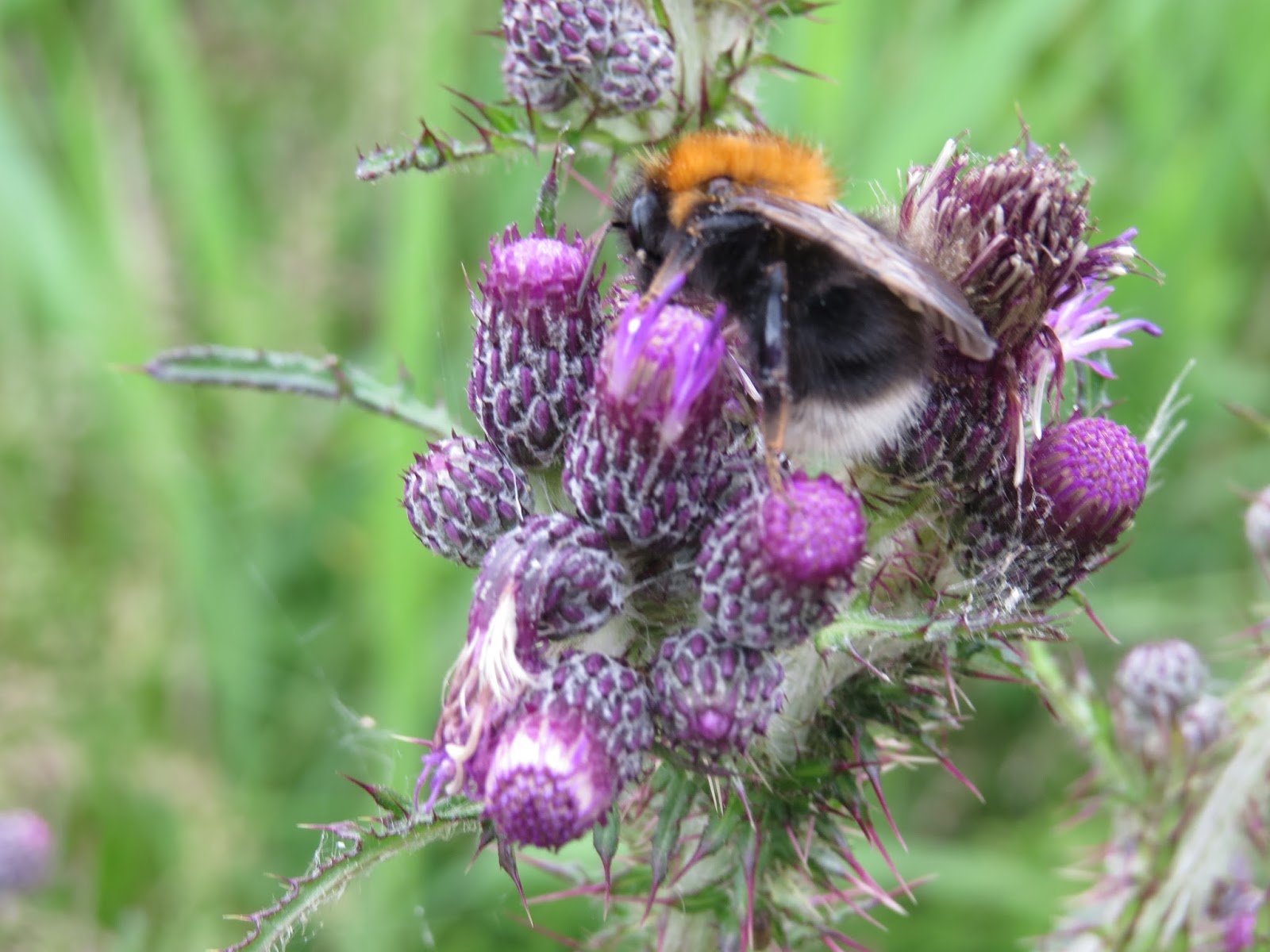
Tree Bumblebee on Marsh Thistle
We eventually came out of the bog and were back onto much sturdier ground. Peacock caterpillars covered large patches of stinging nettle. But not all the nettles here can sting you, as Richard demonstrates with another species called the fen nettle. Marsh harriers flew over us as we looked at more special plants. We came across a Norolk hawker, four-spotted chasers and azure damselflies as well as a hobby as we made our way towards where the fen orchids were growing.

Peacock Caterpillars
Fen Nettle
Marsh Harrier
Greater Spearwort
Marsh Thistle and Bumblebee
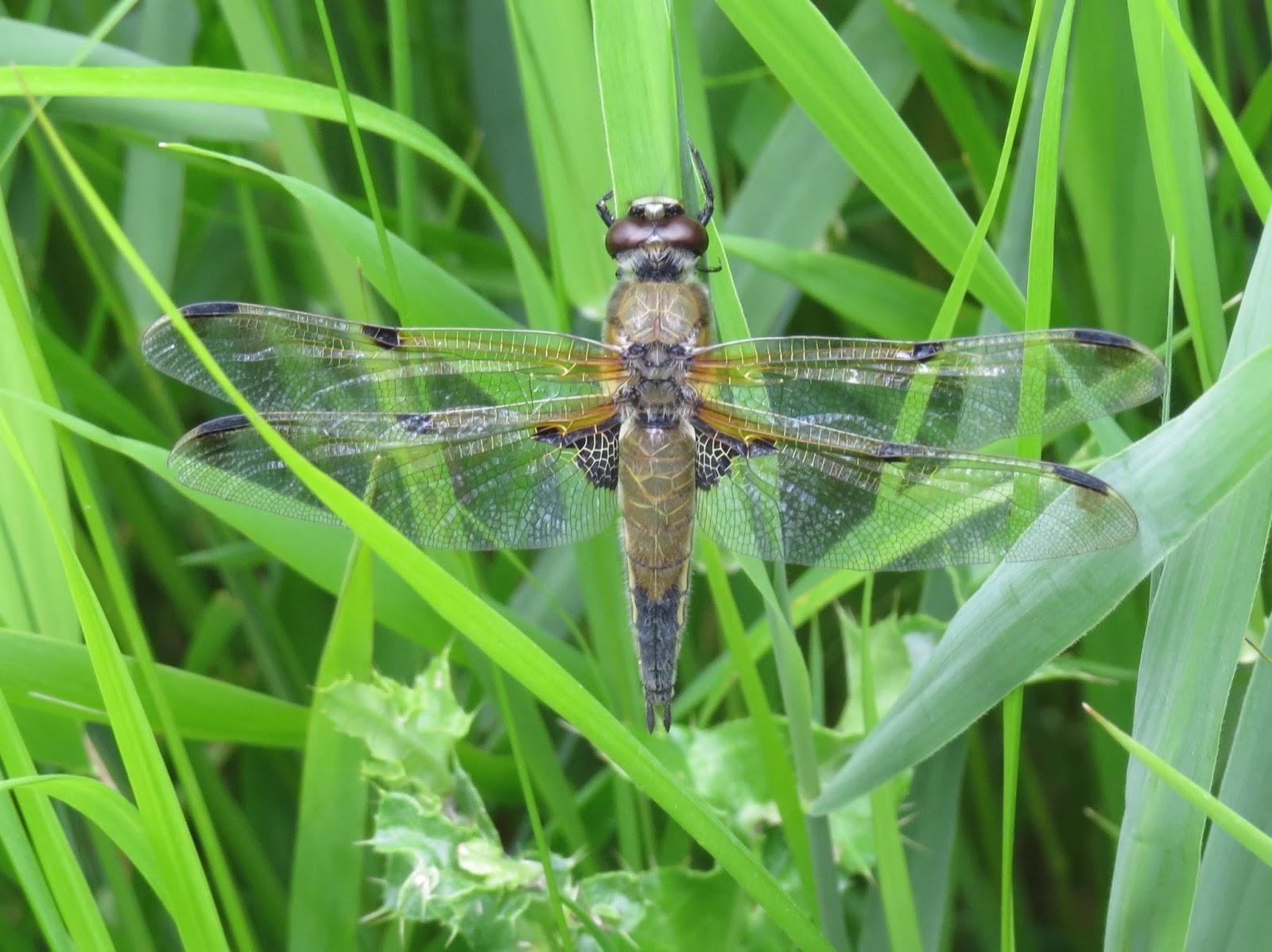
Four-spotted Chaser
Azure Damselfly
Buttercups
Mixed Wildflowers
Spot the fen orchids!
Richard led us past a paddock of buttercups and a paddock of mixed wildflowers. Then we had to cross an electric fence (which Richard turned off for us). We were taken to an area which was slightly boggy but full of ferns and... fen orchids! These plants were hard to see by ourselves as fen orchids are green and blended in with everything else growing here, which was also green. If it wasn't for Richard, we could have easily had walked past them without knowing they were there. They were so tiny, but once you've got your eye in, there were many clustered together in several small patches.

Can you see them now?
Fen Orchid
 Richard told us that many people get disappointed when they see these plants. I could see his point. They are tiny, green and easily overlooked, but the fact that they are rare and found here and three other places in the UK makes them rather special in my eye. The flowers are green, delicate and look like tentacles. Some poke out above the canopy of ferns in their minature world, like royalty looking over their kingdom from the top balcony of their palace.


There was a couple of other rarities to see before we we had to leave. First was the crested buckler-fern, a critically endangered fern which grows here and one other site in Norfolk and nowhere else. Our other rarity was a swallowtail. This large beautiful butterfly (our second of the day) landed in the kingdom of the fen orchids, giving us great views before flying away. To finish off our guided tour, we came across an early marsh orchid and then the largest, most impressive fen orchid of them all. What an adventure!

Royal Fern
Swallowtail
Early Marsh Orchid