Wednesday, 22 July 2015

July 22nd Strumpshaw Fen

The (not so) secret boardwalk
I decided to make a visit to the boardwalk at the other end of the reserve before I started my shift today. Normally, you would have to walk a long way from Tower Hide to get there, but this boardwalk is near the other crossing point over the railway that leads you out of the reserve. You can avoid the long walk by just hopping over the styles and over the railway track to get to there. What brought me to this part of the reserve? Caterpillars. I was looking for swallowtail caterpillars on the milk parsley, which is the food plant for this subspecies. Unfortunately, it was a search without success. No caterpillars to be seen here today, but at least I got to see a nice variaty of reedbed plants and butterflies while I was searching for them.

Milk Parsley
Milk Parsley from the side
Hemp Agrimony
Great Reed Mace
Bittersweet
Meadowsweet
Tufted Vetch
Gatekeeper
Peacock
Swallowtail Caterpillar
But I wasn't going to give up my search that easy. I asked one of my colleagues, who happens to be one of the wardens here, if he had seen any yet. I was told there was some on a lone milk parsley by one of the places we use for pond dipping. True to his word, I managed to find one caterpillar up the stem of the plant. It was very small, but it was much bigger than when it hatched from it's egg. When newly hatched, a swallowtail caterpillar will fit within your fingernail and is black with a white stripe in the middle like a belt. This guy is now developing it's green pigment and black stripes with orange spots. I can still see the 'belt' patch still, but it is beginning to fade. It will now continue growing until it is twice the length it is now and it will become a brighter shade of green with a bolder pattern of spots and stripes. It will be as beautiful as the butterfly it will become.

The new view from Reception Hide
The view from Reception Hide is different than it was last week. Between that time, the reedbed that was starting to be overgrowing in front of the hide has been strimmed down. It happens every year around July and August, after the breeding season has finished, so that our visitors can see things out on the reserve again without it being obstructed by the reeds. It sounds bad to destroy a reedbed like this, but reeds are fast growing plants and will grow back again next year. If you leave a reedbed to grow for years on end, it will become a carr woodland and that isn't a good place for birds like bitterns, marsh harriers and reed warblers to nest in.


GreyHeron
It was rather quiet while watching out onto this improved view. The young marsh harriers were still calling for food and were strengthening their flight muscles with soaring flights over the reedbeds. The youngsters also practiced their food passing skills with a game of 'tag'. One would swoop to the other from below and grab it's sibling's talon. There was no food involved as far as I could tell. I also saw kingfishers this morning for a brief moment on a couple of occasions, two together during one of these moments. Also about today were lots of swallows skimming the water for a drink and a couple of herons and common terns fishing.


Filling up the new icecream freezer
When arrived at Reception Hide this morning, I noticed something new inside. An icecream freezer! Incredibly, we have never sold icecreams at Strumpshaw before and I reacted like a kid in a sweet shop! It was empty at first and we were waiting for the first ever delivery of icecream to be made. Then a man with lots of boxes arrived. The freezer was soon filled with hundreds of tubs of icecream and my colleague and I had the honour to eat the first tubs of icecream to be eaten at Strumpshaw. I felt like I made a little piece of history, a delicious strawberry-flavoured piece of history!

History being made and it tastes sweet!

Tuesday, 21 July 2015

July 21st Theberton

Purple Emperor watching at Theberton
A beautiful butterfly has brought me to a woodland in Suffolk today. As the swallowtail season is at an end, July marks the emergence of the UK's second largest butterfly. The male purple emperor is a stunner. It has shiny, metallic purple-sheened wings that makes it appear exotic. The 'empress' on the other hand, lacks the purple sheen and is instead brown. Purple emperors live in the canopy, at neck aching heights. They can be quite hard to see at times and can seem like they are cursed to those who have tried but failed to see one. I had tried emperor hunting once before in Northamptonshire in 2013, but failed narrowly after missing out on one that was apparently a few feet away down a path I was walking on. I didn't see it fly away at the time and it felt like I had a bad luck spell that was casted upon me.


I am at a wood near Therberton in Suffolk with my two companions from Mousehold Heath; Will the Mousehold warden and David, who helps out at events at Mousehold and was the one who told us about this site. Will happens to be a purple emperor virgin just like I am and we both want to see one badly. When we arrived at the site, it seems that we are not the only ones. A gathering group of butterfly enthusiasts and some conservationists, that were here to study the emperors, were already looking for them in a clearing near the car park. Instantly, I got my first glimpse of a purple emperor! It glided around the tree tops at quite a pace, disappearing under the shade of each leaf and reappearing again as it re-enters sunlight. A purple emperor seems to be always on the move!

A feast fit for an emperor!
To draw them down to our level and keep them there for us to get decent look, a sheet is spread on the ground with what seems to be a picnic. But this is a picnic for purple emperors, not for humans. Foul smelling food is left on the sheet, from rotting pineapples and banana skins to shrimp paste. Why? Well, all this vile stuff is full of nitrates, salts that are missing in the butterfly's diet up in the canopy and they will often come down to feed on stuff like dog poo, etc to extract these salts. Did any emperors come down to our picnic? No, but we did see several flyng in the area around it and on a couple of occasions, they did fly low over it. Unfortunately, none of them came in to land and as they were fast moving, I failed in getting a photo of one. I have to settle with drawing one instead.
Adding shrimp past to the picnic. Yum Yum!

Purple Hairstreak
Apart from the emperors, there were a lot of other butterflies around. Peacocks, red admirals, commas, meadow browns, gatekeepers, small and large skippers and many large whites fluttered around us to pollinate the thistles and brambles closeby. Two other tree top specialists also came down to our level, unlike the reluctant emperors. A silver-washed fritillary gave us a quick visit at a bramble patch, while purple hairstreaks kept landing at ground level for short moments and was the only one of the two that I managed to get a photo of. The fritillary was a bit fast moving for me as if it was pretending to be a purple emperor. Fortunately, I do have a photo in my collection from 2013, when I came across some at Holt Country Park. All of these butterflies were bonuses for me today, it was as if the emperors have cast a spell of good luck on me this time around!
Silver-washed Fritillary (Holt Country Park 2013)
Comma
Large White
Small  Skipper
Common Darter

Monday, 20 July 2015

July 20th Cley

Reed Bunting
If you struggle with your wading birds, your not alone. Although I consider myself good enough to ID waders with a reasonable level of confidence, now and then it is good to be surrounded with other birders in a hide for a second opinion. My mum on the other hand, needs all the help she can get. Waders vary a lot in plumage at this time of year, with each individual looking different to another of the same species. At least today at Cley, the waders are at decent enough range that our binoculars can pick out the details and my scope is also on hand for an even clearer view. My camera was a bit hit and miss due to distance and heat haze, but are good enough to ID with.

Spoonbills
While looking out of the hides, the easiest birds to pick out were the ones that are white. Instantly drawing your attention were the eight sleepy spoonbills on one of the islands. They are so big and white that you can not mistake them for anything else. Beneath their long legs, the ground was black and white. Avocets were keeping them company. Meanwhile, close to the hide, was a little egret fishing while looking elegant in its breeding plumage with its plumes waving in the breeze.

Avocets with a Spoonbill
Avocet
Juvenile Avocet
Little Egret
Next island to the left of 'Avocet Island' was an island covered in red plumaged birds with long beaks and legs. These were black-tailed godwits. Most of them were still looking smart in their brick-red breeding plumage, even if they were too tired to show it off to us this afternoon.

'Godwit Island'
Black-tailed Godwits with Great Black-backed Gull
Other easliy recognisable waders we can see out on the scrapes today were; lapwings which are green with a long, thin crest on its head, dunlin which are small and dumpy birds with black bellies and the black and white oystercatchers with their long orange bills. With a little more observation and you can pick out the ruffs and greenshanks from the crowd. The ruffs all look different from each other at the moment and look rather patchy, but this patchy-ness in their plumage can help tell you that it is a ruff and not a redshank. The greenshanks, meanwhile, are big with grey-green legs, dark grey back, white underparts, a pale but streaky head and neck and a long, slightly upturned beak.
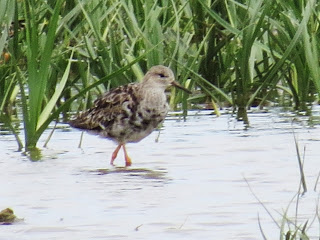
Ruff
Redshank
Greenshank
Common Sandpiper
One of the trickiest groups are the sandpipers. Today, we were fortunate to see three species on the scrapes; Common, Green and Wood. They bob their tails uncontrollably, which is characteristic of a sandpiper. With these three species, I have a good tip to help you remember them. All three are different in sizes and I remember them through 'Godilocks and the three bears. The common sandpiper is the smallest (Baby Bear) and has a white crescent in front of the wing. The green sandpiper is medium sized (Mummy Bear) and is white-speckled, dark grey-brown above with a bright white belly and greenish legs. And finally, the wood sandpiper is the biggest (Daddy Bear) of the three and has a cream-spotted, brown back with long yellow or orange legs. The wood sandpiper is the scarcer of the three and is one of the few waders that nest up in trees.
Green Sandpiper (from last year)
Wood Sandpiper
Wood Sandpiper (again)

All the waders then suddenly took up to the air at once and scattered back down to the scrape, making them look even busier than they were before.

If you love gulls, then you may like this little gull. These gulls are like tiny versions of black-headed gulls. When they fly, take a look at the underwings, which can be black or smudgy-grey. It is something that can stand out easily if seen well.

Little Gull
Finally, here is one final wader for you. It is a juvenile little ringed plover. At least I think it is. Juvenile ringed and little ringed plovers can be hard to tell apart. The eye-ring and the black bill does make me think it is a juvenile little ringed plover though.
Juvenile Little Ringed Plover

Either Sea Bindweed or Field Bindweed (not sure)