|
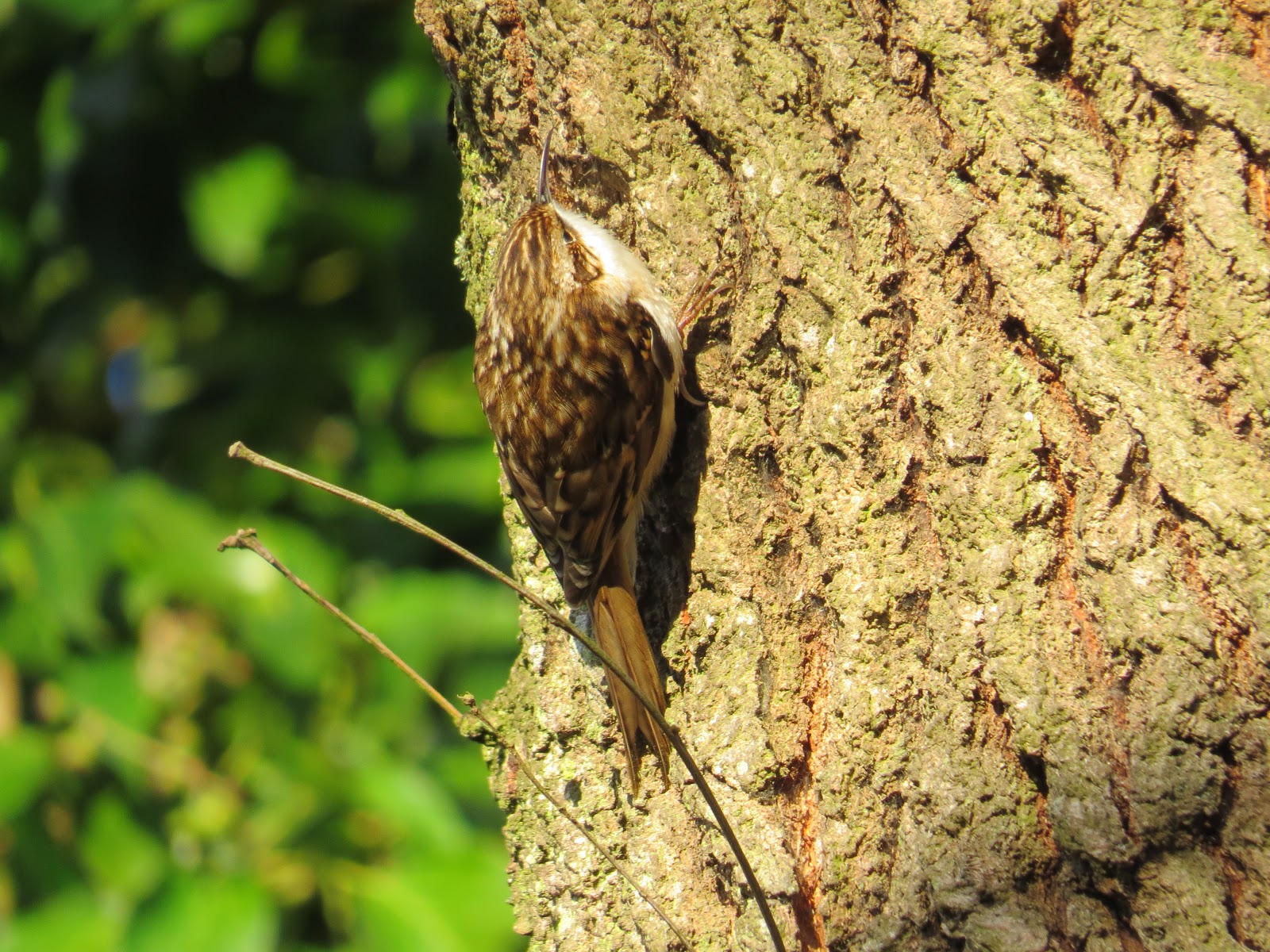
| Treecreeper |
It is nice to feel the spring-like warmth of the sun on my body once again. The wet, foggy, icy and windy weather that I've experienced nearly every Wednesday at Strumpshaw so far this year is long forgotten. The birds are singing proudly and the drumming of great spotted woodpeckers echo the woodland areas of the reserve. Treecreepers trill their calls as they spiral around tree trunks in front of me. It seems spring is here at last!
 |
| Wren |
 |
| Buzzard |
 |
| Smooth Newt |
As it was a nice day, I thought it was about time I got serious with my year-long ultimate bug hunt challenge. Though most of the things on my list that I created are not out yet, I can still keep my eye open for pill woodlice, leopard slugs and earthworms. It was time to roll over some more logs to uncover what's hiding underneath. I gently lifted some small logs up beside the path of the woodland trail and I found something that I thought resembled a slug of some kind. I attempted to pick it up, when it suddenly moved unslug-like, in which made my drop it in surprise. It was a newt! I then found second one under another log as well as some woodlice (none of them were pill woodlice unfortunately). I expect both these newts were annoyed with me for disturbing them from their long naps. I guess I would too if someone woke me up, took my duvet off me and stared at me while I'm still half asleep. Don't worry, after a few photos, I placed the logs back down so that they could get back to sleep again.

 |
| Common Woodlice |
 |
| Earthworm |
Under a different log, I finally found an earthworm. However, this was not your average earthworm. It was rather lively and when I picked it up, it moved more snake-like on my hand. Though I am no worm expert, I think this was a species found in woodlands. It just looks different to your typical common earthworm as it appears grey with red ends and middle. In case you didn't know, the pointy end is the worm's head, the broader end is it's tail and the middle part is called the saddle or clitellum (the sex organ of a worm - worms are hermaphrodites, meaning that they have both male and female reproductive parts). As I've never stated which of the 27 or so species of earthworm found in the UK I wanted to tick off on my list, I've decided that this interesting worm can represent them all for me.

Your probably wondering why I placed an earthworm on my list in the first place. Unlike the other invertebrates on my list, earthworms are not on it because they are rare or colourful. They are on my list because they are important and rather fascinating creatures. Without earthworms, our planet would be in a lot of trouble. They recycle dead leaf matter, pulling them into the ground, allowing them to rot down in their tunnels creating vital compost for plants. Their movements underground also mixes the soil like miniature ploughs. On top of that, earthworms are food for many animals that we love such as birds and hedgehogs. So I think you can agree with me, especially if your a gardener, that earthworms fully deserve to be on my list.
 |
| Chinese Water Deer |
At Fen Hide, I was busy photographing a Chinese water deer grazing in an open area of reed stubble, when a visitor in the hide with me spotted a fox at the back of that area behind it. I only managed to get a glimpse of it before it went behind a strip of reed bed and again as it dashed out onto a second open area until it vanished completely behind a bigger section of reed bed. It moved so quick, I was unprepared to photograph it. I waited for a while in case it came back, but it didn't. So I then went down to the river to see great crested grebes and to check the conditions of the path. It was still pretty muddy, but it wasn't as bad as it usually is during these early months of the year.
 |
| Mute Swan |
 |
| Great Crested Grebe |
 |
| Reed Bunting |
 |
| Marsh Harrier |
 |
| Greylags |
From Reception Hide, it was a bit quiet with not much to see. Though a lot of the absence of birdlife was mainly due to a black helicopter flying stupidly low over the reserve causing everything to disperse. Its just like those fighter jets from a couple of weeks ago all over again! Before this helicopter showed up, I was watching greylag geese, shovelers, a tufted duck, two pochards, a little grebe and a couple of marsh harriers. All that remained after the helicopter passed by were a coots, a few teal, gadwall and some mallards that were busy mating at least three times.
 |
| Tufted Duck |
 |
| Pochard |
 |
| Little Grebe |
 |
| Mallards |
 |
| Mallard displaying to one another (involves a lot of head bobbing) |
 |
| Mallards mating |