Sunday, 28 February 2021

The Month of Love (For Birds)

 Feb 2nd  Norwich

With lockdown continuing on into February, it meant that for the second month of 2021 I had to rely on the city for my wildlife fix once again. My bird list was at 57 species by the end of January and and my hunger for adding more birds to the list was growing as much as the list itself was. Covid was just background noise. All I could think of were birds and where to find them. I was becoming an urban birdwatcher, constantly listening out for something I haven't heard yet and scanning every tree as best I can. I couldn't believe how many species I've seen already within the boundaries of Norwich, including things like parakeets that I had no idea could be found here.

After an appointment with my osteopath, I went for a walk around the city centre, mainly along the river. I was hoping to find grey wagtails, but they proved to be quite elusive. However, I did spot a peregrine perching half way up the cathedral spire. I expect that they are now starting to pair up and preparing for their latest clutch of eggs. I haven't really been following their progress in previous years. All I know is that they have been quite successful since a pair first nested there 10 years ago. Back then, it was the first time in a very long time (about a century, if I remember rightly) and the fact that peregrines are still breeding here just proves how much of a success story they really are. The peregrines at Norwich Cathedral have became local celebrities, attracting thousands of people interested in their latest chapter every year. The Hawk and Owl Trust have done a great job monitoring them and you can check out a livestream on the nest box on their website. https://hawkandowltrust.org/web-cam-live/norwich-cathedral-side
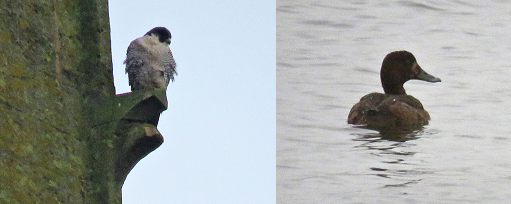
Peregrine (Feb 2nd) and Scaup (Feb 6th)
Feb 5th Sprowston

I was dropped off at the Sprowston Park and Ride car park after food shopping with my mum. I wanted to check out if any 'rural' birds still lingered here where the city is still growing into the countryside. Despite the busy traffic drowning out most of the birds, I was still able to hear a skylark or two singing somewhere high in the sky. I remember seeing fieldfares at the nearby Sprowston Hotel when I was once a member for the pool and so I had a quick sneaky peek by the entrance this morning to seek them out. There was a large mixed flock of thrushes gathered behind their lake such as redwings, mistle thrushes and song thrushes. I believe that fieldfares are there too, however I couldn't get a good look at them, so I'm leaving them off the list for now. On a ploughed field on the opposite side of the road, I was hoping for pheasants or something of the likes, but could only spot a few stock doves and woodpigeons.

Feb 6th Whitlingham Broad

A scaup had me back at Whitlingham on a very miserable day. I was told that a 1st winter female had been seen in the last few days hanging with the tufted ducks on the broad. The thing is, female scaups look a lot like female tufted ducks. A very daunting challenge, especially when it is pouring with rain and got rather misty. However, scaup are slightly bigger and with a more rounded head. This information really helped me out when I eventually found it in the wildlife friendly corner of the broad. This was a massive tick for me as scaup are scarce winter visitors to the UK and I've only seen a handful in my lifetime.

As well as the scaup, I also added pochard to my list as well as audible additions of reed bunting and bullfinch, which I only heard a couple of notes before it went silent and couldn't locate it. A large flock of siskins were feeding on alder cones (but try as I might, I couldn't find anything in the likes of brambling or redpoll), a redwing and a brief flyby over the river of a kingfisher. It turned out to be a very successful day worth getting absolutely soaked to the bone for.

Feb 10th Catton Park

My 2nd dawn chorus of 2021 couldn't had been any more different to January's. A snow storm had hit for a few days and I decided to experience this latest dawn chorus in it to see if the birds were as active. I arrived at the park at the same time as before and seemed to be a lot more darker to begin with. Only the robins and the odd song thrush was in voice at this point. 

As I waited for the light to improve, I was suddenly hit by a short snow flurry that hit me like a blizzard. As sudden as it appeared, it was soon over and the birds took advantage of this break in the weather to sing. It was like someone flipping a switch as I could now hear blue tits, dunnocks, chaffinch, stock doves, blackbirds, a nuthatch and a green woodpecker and in the woods, I had great views of treecreepers. It wasn't as good as January's chorus and I was filming it with a low battery as I forgot to charge my camera's battery, however, it was still an interesting experience nonetheless.


Feb 12th Norwich

Returning home from a night at work, I was about to open my front door when I heard a short hoot from a tawny owl. Though I didn't see it, that brief hoot was enough for me to add to this owl to my list.

Feb 13th Whitlingham Broad

Another Saturday morning at Whitlingham. No rain this time, but a lot of snow and ice on the ground. It was freezing and slippery in places, but at least it was a nice day. I was in search of another duck, a pintail. Sadly, I was a couple of days too late. However, it was now replaced by yet another scarce duck, a female smew. Thanks to a few local birdwatchers, I was quickly on it pretty early on during my latest visit and was able to see it on the other side of the broad.

A bittern was also reported showing well on standing out on the ice at the wildlife area of the broad. I went to see and passed someone who confirmed that it was still in good view. A couple minutes later, I reached the spot and... IT WAS GONE! I was so close to add bittern to my list! It was one of those 'should have been here a few minutes ago' moments. The only other new thing for my list were pochards.

Smew (Feb 13), Curlew and Snipe (Feb 14th)

Feb 14th Earlham Marshes & Norwich

It was Valentine's Day, but I was not looking for love, but birds instead. Dad and I went to visit Earlham Marshes for the very first time as I was told that little owls were apparently there sometimes and great white egrets have been overwintering there as well. Unfortunately, not this time. Ice dominated the landscape and it was freezing to hang around for too long in. A variety of gulls stood on the frozen surface of the lakes, but nothing that I could convert into a Caspian gull or anything of the like. But, I did manage to tick off a pair of stonechat, a displaying lapwing and a sparrowhawk to satisfy my species list.

We then moved on to the spot we saw the parakeets last month and focused on the flooded marshland between Hellesdon Road and the Marriott's Way. This landscape was also frozen over and had apparently attracted a few waders, a bit of a rarity this close to the city centre. Though waders are rare near the city, curlews are even rarer. So to find two of them feeding out on the frozen marsh, made me really happy indeed. It turned out that this place was a bit of a goldmine as it provided 3 other species to my ever growing list with meadow pipits, pheasants and snipe. We also had a little egret, heard the parakeets again and I'm pretty sure a woodcock flew past us, though I could be wrong and was just a snipe.

Feb 17th Whitlingham Broad

After receiving my first Covid vaccine, I went for yet another visit to Whitlingham. A black-necked grebe was my latest target here, but was unable to find it. However, I did manage to add a great black-backed gull and about 6 or so little grebes as well as seeing a kingfisher and a female goldeneye, pochards, gadwall, tufted ducks, a heron, cormorants and great crested grebes. 

Feb 23rd Mousehold Heath & Norwich

A long walk around both sides of Mousehold Heath, seeing a kestrel, jays and the usual finches and tit species, then a short stop at St James' Hill, spotting 3 peregrines circling the cathedral and encountering a kingfisher as I made my return home via the river.

Feb 24th Whitlingham Broad

Mum surprised me with a trip to Whitlingham out of the blue. Nothing new for my list this time around, sadly.  However, it was a nice day and we saw siskins, tufted ducks, pochards, cormorants, gadwall, great crested grebes, a kingfisher and I had a brief glimpse of a Cetti's warbler.

Plant List Update

With spring around the corner, the year's first new plant species have been appearing recently. As I'm also continuing my lockdown plant list from last year as well as this latest bird one, I'm keeping one eye out for the latest blooms at the same time across the city of Norwich. Snowdrops, daffodils, a variety of crocus species, stinking hellebores, winter aconites, winter heliotrope, common whitlowgrass, corn salad and blackthorn are just some of the latest additions and I expect there will be a few more before I call quits on it in May, completing a full year. 


Sunday, 31 January 2021

A New Year, A New Lockdown, A New Challenge

 Jan 10th & 12th Catton Park

A new year, a new lockdown. 2021 hasn't started any better than how 2020 ended has it? We're pretty much back to how we were last spring but with the situation being much, much worse. Strumpshaw is once again closed and I am unable to volunteer once more. I was planning to do a new challenge to celebrate Strumpshaw's 45th anniversary, but that's now been scrapped (at least for the moment). 

After a week staying home, only going out for work and shopping, I had some time to think of a plan B. I have decided to do a local bird list for 2021. Just like my plant hunting of last year, the idea is to find as many species of bird within my city's borders. That means I can not include anything outside the city. Though my plant list will definitely be bigger than this bird list, it will still be interesting to see how many I can find. I can add them if I see or hear them, though seeing them would definitely be the better option. Of course, you are very welcome to let me know if you hear about a scarce bird that I didn't know about (I usually end up finding out a day later most of the time).

As I can't travel very far at the moment due to lockdown, I am restricted of places to go. My local park didn't fail to surprise me last year, so it seemed like the best place to start. And during two visits in the 2nd week of the month, it proved itself once again. In these two visits (and near my flat), I built my list with; kestrel, pink-footed geese (flying over), redwing, common gull, stock dove, buzzard, blackbird, carrion crow, jackdaw, magpie, jay, woodpigeon, collard dove, black-headed gull, blue tit, great tit, robin, long-tailed tit, great spotted woodpecker, wren, dunnock and feral pigeons. Not a bad start at all.

Kestrel (Jan 10th), Egyptian Goose & Barnacle Goose (Jan 13th) and Common Gull (Jan 15th)

Jan 13th Whitlingham Broad

Whitlingham Broad was to be the furthest place I've been to this year so far. Mum and I had a long walk around the main broad. Half of the track round it was fine, but the other half was extremely muddy. However, winter is a great time for birds here and there were plenty of new species to add to the list. Great crested grebe, pied wagtail, lesser black-backed gull, herring gull, greylag, Canada geese, Egyptian geese, a single barnacle goose, mute swan, gadwall, tufted duck, mallard, cormorants, coot, moorhen, a little egret and a grey heron, and I also heard kingfisher, siskins, Cetti's warbler and water rail. That's 43 species in one week.

Jan 15th-21st Norwich

Since Whitlingham, I had been exploring the city, mainly the parks and Mousehold Heath. On the 15th, I went for an afternoon walk along the Marriot's Way and to Wensum Park. I heard that there were a yellow-legged and Caspian gull here, both in their juvenile/2nd winter plumage. In other words, you have to be a real expert to distinguish them from the other gulls. Let's just say I took a few photos of the ones that could be them but left them off the list to be on the safe side. On the 17th, I visited Catton again a day after it snowed. Nothing of note in the end and the snow was reduced to tiny patches and boulders of snowman remains. On the 21st, I had a very muddy visit to Mousehold. Again, nothing new to add, but I did have an encounter with a low-flying buzzard and another with a large family of long-tailed tits.

Jan 25th Catton Park

For once a month this year, I want to add an extra challenge on top of my bird list challenge. I want to experience a dawn chorus for every month. I wanted to see what is like month by month and changes between the species. I want to find how it differs throughout the year.

 A dawn chorus in January was a chilly thought, so I really didn't know what to expect. It was a very frosty morning and I was glad to have worn a couple of layers before setting out to Catton Park. The thing about this time of year is that it is a good time to learn bird calls and songs as there are fewer species around compared to the spring when all the migrants arrive. At 7am, the birds were already beginning to find their voice as the darkness of night was fading away. Robins and wrens were the main singers at first with some blackbirds were making some alarm calls, but they were soon joined by song thrushes and woodpigeons. 

Minutes passed and I started hearing blue and great tits, goldfinches, a goldcrest, chaffinch, a buzzard and a green woodpecker. The light was improving by the minute and I now able to see the birds in more detail. I could now see the gulls fly above me as well as a kestrel and a jay. The park was looking like a winter wonderland with frost sparkling in the early morning light. It was chilly with the temperature below 0 and yet I was surprised to see so many people up and about walking their dogs. It didn't disturb the common gulls that flocked onto the icy field and the great spotted woodpeckers that I found drumming on the branches of one of the old oak trees. However, the dogs did disturb me and I decided to call it quits after one bounded up at me. On the way out though, a flock of redwings appeared and gave me some great views. It was a great first dawn chorus. It may not be the liveliest, but it sure had a lot of birds to experience. 


Jan 28th Wensum Park

Another attempt at the scarce gulls at Wensum Park. It was a bit drizzly, but at least this time I found one of them. Despite being called a yellow-legged gull, this one hadn't developed the correct colour just yet. Being a 2nd winter bird, its plumage wasn't fully developed into its adult feathers just yet either. At this point, it looks similar to a young herring gull. However, it looked different enough to draw my attention. I took a few photos of it and emailed it to someone I knew who would confirm that I found the correct bird. He replied and I was 100% correct with my gut feelings. (Thanks James!) 

Yellow-legged Gull and Ring-necked Parakeet


Jan 30th Norwich

I was informed that ring-necked parakeets were in Norwich by the Ring Road. I've seen them in London, but I never knew these exotic, colourful birds were even here until recently. After watching Norwich play out a 0-0 draw against Middlesbrough in a lunch time kick off, I went out with Dad to go look for them. It was a long and muddy walk as we ventured through a flooded tow path until we reached the possible area I was informed that they usually hang out. An area of tall trees sandwiched between a flooded part of the river Wensum and a built up area of houses and a road was echoing the squawking calls of a flock of at least 10 bright green parakeets that were restless at times, circling the buildings with a continuous noise. Even with the light fading into a dim fuzz, the bird's exotic colour was clearly visible. This was without doubt the most unusual addition to my list. A stand out encounter in the middle of a winter lockdown.

Jan 31st Norwich, Thorpe Marshes and Whitlingham Broad

It was the RSPB's Big Garden Birdwatch weekend this weekend and it is a great thing to do while being stuck at home during a lockdown. This is an annual survey to monitor the UK's garden birds. All you have to do is count the birds that visit your garden within an hour. That is pretty much it. Today, as I'm in a support bubble with my parents and I don't have a garden myself, I went to count their birds like I always do every year. Dad and I did our hour this morning and counted; 2 blue tits, 2 dunnocks, 1 blackbird, 1 woodpigeon, 1 great tit, 1 starling and 1 greenfinch as well as 2 redwings that we couldn't include as they were just refused to enter our garden.

After lunch, Dad and I went out to Thorpe Marshes in the hope of adding more birds to my list. I was told to bring wellies and for good reason. It was flooded! Half the reserve was underwater and the other completely muddy. As I was the only one between the two of us with wellies, I had to go it alone. Surprisingly, there were a lot of families out here for a walk. You had to get through 2 small flooded sections to even attempt a walk where it is just manageable. They seemed as crazy to bring their kids and walk their dogs here as much as I am to birdwatch. The rewards wasn't that great either as I only managed to add a flock of teal to the list. The rest are what I've already seen at Whitlingham a couple of weeks ago.

It was a slow slog back through the mud and water. Thankfully, the water washed away the mud from my wellies, so I didn't have to clean them off when I got home. However, we weren't going home just yet. Our final destination of the day was at Whitlingham as I was told that a Mandarin duck comes in to roost at the main broad. Not only that, but also a great white egret does too. Sadly though, despite waiting until it got too dark to see, neither bird showed up. But there were a couple of constellations, a kingfisher perching right by the shore in front of us and a spectacular male goldeneye amongst the large roosting raft of tufted ducks out in the centre of the broad. Not what I was hoping for, but still a great way to end an eventful month of extremely local birdwatching.


Thursday, 31 December 2020

My 2020: Review Of The Year

 Let's face it, 2020 was a bad year for all of us. The pandemic has dominated everyone's lives. Either by getting the symptoms yourself, losing a loved one by it or even your job because your business has shut down due to the lockdowns that are in place to reduce the spread of the virus. There's also other things that makes 2020 a year to forget, such as the race riots. But while the world has been fallen apart, I have been trying to keep my mind from thinking about it all and try to distract myself with as much wildlife as I could in such circumstances. So here's how my 2020 went down...

January

It all started quite well. It was a new year and a new decade. The virus was still far away in China to make any impact on my life. I was more interested in starting my new challenge in finding and photographing bird species that I missed over the years. January was a great month for me as I had encounters with a ferruginous duck at Ranworth Broad, a field full of cranes outside Acle and a Slavonian grebe at Wroxham Broad. However, my thoughts weren't completely on birds that month as my granddad was taken into hospital due to heart problems. He spent a few months in hospital, but I'm glad to say that he's made a full recovery since then, at least for now.

February

February was the last full month before the coronavirus outbreak reached the UK. For me, it was a month of owls. The real highlight was travelling to Ipswich by train to see a rather special bird. I had heard of a tawny owl that regularly roosts in a tree in a park there. Although I have seen tawny owls at night before around Norwich, I had never gotten a photo of one before. In Ipswich, this individual has became a local legend, with an owl roosting in the same tree every year since 2007. Though it did disappear in 2017, it returned in 2019 and it was back again this year. It felt rather special to finally see this bird sleeping in full view high up within a hollow of a tree. It was worth the trip as a Norwich City fan into enemy territory to see this beautiful owl.

The rest of the month included a great view of an otter that came out onto land to feast on a fish and a barn owl that landed extremely close to me along the path towards the pump house at Strumpshaw.

March

There was one last adventure before the chaos truly began. During the week of my birthday (March 11th), my parents took me on holiday to Dorset. Despite the weather being a mix bag of rain and sunshine, the week-long trip was fantastic and included a visit to Durdle Door (a famous picturesque sea arch), a spot of fossil hunting and a couple of days at RSPB Arne, where we had great encounters with Dartford warblers and Sika deer. By the end of our stay in Dorset, my adventure didn't end there as I was taken to the Forest of Dean to spend the weekend with a Naturetrek group. Though it was a short extension and the weather was for the most part made things awful with heavy rain showers and extremely muddy paths, my guide made sure my group saw some amazing wildlife that made this forest home. Wild boar with piglets, hawfinches, goshawks, peregrines, little owls, crossbills, ravens, we saw quite a lot of amazing things. However, the highlight had to be seeing my first ever great grey shrike.

The week after, lockdown was announced and when I returned to Strumpshaw, the reserve was yet to decide if to close or not. In the end, after an hour of my shift in Reception Hide, they had made the decision to close up. I had one last walk around the reserve, seeing a barn owl. It would be another 9 months until I could volunteer at Strumpshaw again. 

April-October

Lockdown brought a lot of restrictions in movement and a lot of boredom from not being able to go anywhere outside of Norwich. In April and early May, I didn't really do that much other than to go out for a walk around my local park or at Mousehold Heath. Spring was in the air and for the first time, I felt that I got to experience it and fully open my eyes to what wildlife I could find on my doorstep. Norwich was as wild as any nature reserve, just a lot more overlooked. There were green hairstreaks, green tiger beetles, green and great spotted woodpeckers, a cuckoo (at Thorpe Marshes) and I even heard a lesser whitethroat and a corncrake (also at Thorpe Marshes). I spent Dawn Chorus Day in my local park and it felt like it meant a lot more to me than previous years.

By mid-May, I decided to get into something I'm not at all an expert in; plants. Throughout the summer, I went exploring around the streets and parks and other places in and around the city limits. What I discovered was an amazing array of flora. From four species of orchid and scarcer species such as arrowhead and flowering rush to hare's-foot clover and sand spurrey. I ended up with a long list of plants that I never knew existed in my home city. I have a new appreciation for plants now and I was sad when the summer ended and my list grinded to a halt. 

As the restrictions relaxed and the first lockdown eased, I was allowed to travel further away from Norwich's boundaries. From swallowtails at Hickling Broad to a few visits to the coast to search for migrants at places like Cley and Titchwell. I even had a couple of trips to Strumpshaw for the first time in months. I experienced the strange new one-way route systems at some of these reserves and being inside a hide with a mask on. It was bird watching, but not how it used to be. Social distancing twitching at Wells Wood in September as we all crowded behind a fence and a couple of hay bales looking at a red-backed shrike was something I wouldn't forget.

In October, it was all about the spectacle of the autumn colours produced by the trees in my neighbourhood. The weather was awful though.

November and December

The final two months of 2020 were the least eventful as I barely went out. In November, a second lockdown was in place, but I did sneak in a couple of outings outside of the city. This included a trip to Titchwell where we got some strange looks but saw some great things from shimmering eruptions of golden plovers and a close encounter with a muntjac deer. While at Strumpshaw I discovered my first ever earthstar fungi.

Finally, in December, I was allowed back to volunteering at Strumpshaw since March. I was rewarded with bitterns, otters and a pintail. It was just great to be back, though it was weird helping inside the Reception Hide while obeying to the new social distancing rules and all the tape marking out where we had to stand and move around in. Just to be back and seeing the wildlife and the everchanging weather changing the landscape I was familiar with before the lockdowns, seeing all of it again made up for all the absent weeks I missed being here. And to top things off, I was rewarded with my 10 year service as an RSPB volunteer at Strumpshaw with a silver puffin badge, even though it is a few months early.

Now that Norfolk has entered Tier 4 (pretty much a 3rd lockdown), I'm unsure on how 2021 will be like. Will I ever be allowed to go on big birding outings again? Will I get the vaccine before I get the virus? Whatever happens, I'm sure that next year will be better than this one. Happy new year, everyone!

Wednesday, 30 December 2020

The Last Shift Of 2020

 Dec 30th  Strumpshaw Fen

Today is my last shift of 2020 and with the new Tier 4 system in place, I was unsure if I was allowed to return back to Strumpshaw at first. But after being told that it was my choice to make, I of course wanted to continue. When I arrived to the reserve this morning, though, I discovered that most of it was out of bounds. The hides were now closed once again and with high water levels, both routes along the river were extremely muddy. So my morning walk before my shift was very limited. All I could really do was walk to the river and back and around the woodland trail. There wasn't much to see either.

Receiving my silver puffin badge

When I returned for my shift at the Reception Hide, Ben showed up and gave me a large envelope. Inside was a certificate and two badges. One was the RSPB logo, the other was in a special box, a silver puffin. The silver puffin badge is only given to volunteers who serve 10 years for the RSPB. I was given this badge a little early than expected as next year marks my 10th anniversary at Strumpshaw. It was a special honour. A late Christmas present and a great way to end the year on.


It was a very cold day today and though the weather was good, there wasn't much to see outside of the Reception Hide. As it was very cold, I went for an extra walk in the woods to warm myself up a bit. At this point in the day, the bird life appeared to be more awake and very active. I stood by the Gnarly Oak for a few minutes and within those few minutes I was surrounded by hundreds of siskins, a few redwings, marsh tits, blue tits, great tits, long-tailed tits, jays and a treecreeper. I tried to spot a redpoll amongst the siskins, but I just couldn't see any at all. On the way back, I had some great views of bullfinches posing well and singing proudly. When I returned back into the hide, the view remained empty other than a flock of sleepy mallards, 3 mute swans, marsh harriers and a sparrowhawk making a quick flyby. Apparently though, while I was on my walk in the woods, I had missed a bittern. Typical! 

Sunrise over the river, Siskin and Bullfinch

Wednesday, 23 December 2020

I'm Dreaming Of A Grey Strump-mas

 Dec 9th  Strumpshaw Fen

Frost and fog outside Reception Hide
My second shift at Strumpshaw since my return was a bit of a grey day (though it was hammering down with rain when I woke up). Extremely thick fog covered much of the reserve and made it very tricky to spot anything. Outside the Reception Hide, the broad was covered in a thin layer of ice as well as the grey soup that was the fog. I spent most of the morning trying to write up the new sightings blackboard for it to go outside. Sadly, my work became a chalky mess dripping down the board. My blackboard duties is now left for someone else (it just takes way too much of my time that I could use to watch the wildlife). The situation with the chalk pretty much summed up that morning's shift as it was a bit of a waste of time with only ducks (including 40-50 shovelers) and the odd marsh harrier to be seen.


Dec 16th  Strumpshaw Fen

Siskins
A much nicer day than the previous week's shift, but the wildlife was still on the quiet side. Pink-footed geese were flying overhead as I made my way to the Fen Hide, which was open but not very productive. Back in the woods as made my return from my early morning walk, I encountered a large mixed flock of goldfinches and siskins (with possibly a few redpolls amongst them, though I personally didn't spot any) congregating on a couple of alder trees, some feeding on the cones, others just twittering to each other. Meanwhile at the Reception Hide, an otter showed up after a couple of hours of me just staring at the few mallards on the broad. I also glimpsed a female sparrowhawk flash by and a few marsh harriers and buzzards circling above.


Otter


Dec 20th  Catton Park

My monthly walk around my local patch was a bit of a disappointing affair if it wasn't for a low flying buzzard and the odd redwing. Other than that, it was a case of dodging everyone's dogs and not finding much of plant life or anything else for that matter.

Dec 23rd  Strumpshaw Fen

This morning was very similar to the one on Dec 9th, grey and wet. When I arrived at Strumpshaw this morning it was extremely foggy, but it soon deteriorated and made way for heavy spells of rain, which was on and off throughout my shift today. Between the showers, I was lucky enough to spot a bittern fly in and out of the reedbeds surrounding the broad. Occasionally it would land into the edge of the reedbeds to the point that you could just make it out or even see the reeds move, bending down by the weight of the bird. I couldn't get any photos sadly as the light was poor and my camera was having a difficult time of focusing on it before it eventually flew off and out of side down into a fairly distant reedbed on the far right side of the broad. 

Shortly after the bittern vanished, an otter appeared. The gadwall and mallard floating on the broad took a while to notice that it was swimming by them all until the fear finally kicked in. The otter hung around for quite some time, maybe an hour, just diving around hunting for fish. There was a moment where it was fighting with something big like a pike before carrying it off in its mouth towards a reedbed in order to eat it. A bittern and an otter, some might say that this is a perfect early Christmas present during a year plagued by a pandemic. A little bit of joy in a world currently full of woe.


Tuesday, 15 December 2020

6 Years On!

It is now 6 years since I started doing this blog and boy, has it been the most challenging year I've ever had. To be honest, I have considered quitting it. Not only has the whole lockdown thing been keeping me from really going very far, Blogger has had a bit of a makeover recently, which has taken a bit of getting used to. You have probably noticed that I don't post that much anymore and when I do, there's a different format to how I usually do my posts. I now write everything I've done collectively whenever I feel like it. However, I'm hoping that I will start a new wildlife challenge or two for next year if things go to plan, so look forward to that.

Now that it is now winter, I just haven't been out much other than work and Strumpshaw on Wednesdays (I will post update soon!). But back in May, after being bored out of my mind during lockdown, I decided to make the most of this plentiful free time exploring the city of Norwich, the place I call home, and to get to grips with a subject I'm not too good at. Plant hunting became an almost daily quest and it gave me some joy in a time which was rather uncertain. I got to visit places near my home that I barely go to and I've discovered some things I never knew I could find in this urban environment.

I only officially started this unexpected new hobby 2 months into lockdown, but I was already accumulating a large list of plants. There were still a few species that were lingering from April when I first started such as honesty, bluebells and cowslip as well as mid-May plants that were only just sprouting like bird's-foot trefoil, ox-eyed daisies, forget-me-nots, poppies and red valerian. When spring became summer, more and more exciting and colourful plants were appearing. Among them were orchids, which I managed to find 4 species (bee, southern mars, common spotted and pyramidal). There were also a few very special species like arrowhead, flowering rush, river water-dropwort, sand spurrey, cudweed and dwarf mallow.

For a city, you'd be amazed on how many types of habitats Norwich has. There's of course the grassy fields and woodlands of the local parks and the river Wensum, but there's also the heathlands of Mousehold Heath, the broads of Whitlingham and the boggy meadows of Thorpe Marshes and Carey's Meadow, not to mention the cemeteries, the tiny patches of unused land and even the between the cracks in the pavement in the city itself. Some of these plants were only found at one site, while many others I found pretty much everywhere. As I'm pretty much a novice at plant IDing, I used an app on my phone to help me out for the most part, though for how accurate it is I'm not a hundred percent sure. I have lost count on the amount of times I took a photo of something yellow only for it being either cat's-ear or smooth sow-thistle. I expect that for every hundred or so species I've found, another few hundred or so eluded me due to my inexperience. 

When autumn came around, it was all about trees. The colours on the leaves were changing and were spectacular this year, unlike the weather which was awful throughout much of October. Just like the wildflowers I've discovered throughout the spring and summer, it was an interesting mix of native and non-native species. Though I tried to exclude escapees as best I could, I only included the ones I found that weren't growing in someone's garden. In the case of non-native trees, I only included the ones along my local streets rather those planted in some of the public parks such as Chapelfield Gardens where so many exotic trees were purposefully planted. 

My list was pretty big to really count or mention fully here, but here's a few other highlights; lords and ladies, wild strawberry, field pansy, ivy-leaved toadflax, groundsel, heath groundsel, common fumitory, meadow saxifrage, celery-leaved buttercup, large bittercress, viper's bugloss, common broomrape, clary sage, biting stonecrop, bell and ling heather, vervain, enchanter's nightshade, hare's-foot clover, dark mullein, fig-leaved goosefoot, amphibious bistort, centaury, soapwort, gallant soldier, sun spurge, pellitory-of-the-wall, corn spurrey, autumn crocus, genko tree, mistletoe.

Now that it is December, the plant hunt has ground to a halt. I will continue the list up until next May to make it a complete year. If you know any plants I can look for from now until next spring, let me know. I would love to find something new before Christmas. Thank you all for all your support on this project so far. I know many of you have enjoyed my urban plant hunting adventures and I'd love for them to continue.

Wednesday, 2 December 2020

The Return

 Nov 22nd  Strumpshaw Fen

While the second lockdown was still going on, I haven't really been doing much other than video games and work. With the days getting shorter and my plant list being on hiatus due to a lack of new plants to add with it being winter, I just haven't had the same enthusiasm for nature as I did in the previous lockdown. So, Mum decided to drop me off at Strumpshaw for a walk to get me back into the mood. 

Earthstars
The latest lockdown meant that all the hides were once again closed off to the public. And with the river flooding the path to Tower Hide, turning it into a muddy mess as it does every winter, there weren't many routes left open to explore other than the circuit leading through the woodland trail and pass the pumphouse. To be fair, there wasn't much to see anyway. I saw more families out for a walk than wildlife sightings on this occasion. However, the real highlight was finding a few earthstars. I've never found this fungi on my own before, let alone at Strumpshaw, so I was extremely pleased with myself. I'm not an expert on fungi, but there was no denying that they were very beautiful to look at, resembling like fungal versions of flowers. I also found plenty of candlesnuff fungi as well as siskins, marsh tits, marsh harriers and a Chinese water deer.

Dec 2nd  Strumpshaw Fen

Today, I have returned to Strumpshaw not as a visitor but back as a volunteer. It was finally time to wear the RSPB uniform once again, the first time since March on the day the reserve closed due to lockdown. It has been a long time waiting and now I had to get back into the habit of getting up at the crack of dawn, using public transport (which I had been avoiding since that day in March) and the walk to the reserve from Brundall station. When I arrived, the moon was still bright in the sky as the sun was rising. A thin layer of mist and frost cloaked the landscape and it was a tad nippy as I made my first walk around the reserve as a volunteer in a while. The view outside the hides was rather flooded, while the hides themselves weren't quite open yet for me to enter (the Fen Hide officially reopened later that morning). There were pheasants everywhere and I had a few encounters with muntjac and Chinese water deer and I even startled a hare that ran pass me along the path to the pumphouse. I also saw pink-footed geese fly over, a snipe and some redwings.

Checking in for my induction into volunteering under Covid-19 restrictions, I was taught how to operate in the Reception Hide safely and even got back into refilling the bird feeders (no sign of Percy the persistent pheasant though). My role now was to make coffees for visitors and place them on a tray for my colleague, Tricia, to collect. I have to keep my distance, sanitise every time I make a coffee as well as wear a mask while I make them and before I leave, I have to sanitise everything I touched in the hide. It was utter madness! If a time travelling birdwatcher from the past was to see how this set up was like, they'd probably think we've all gone insane and I wouldn't blame them. But this is  how things are now. I was just happy to be back despite all this crazy nonsense behind the scenes.

Otter, Frosty Sunrise at Fen Hide and Pintail

While everything inside the hide was bonkers, everything outside it was a welcoming distraction. It felt like the wildlife was welcoming me back in style as a good chunk of my first shift back in the hide was dominated by the presence of an otter that was hunting out on the broad. It even caught a couple of fish during its long stay, feasting on one of them (possibly an eel) within the reedy islands. And the otter wasn't the only big highlight celebrating my return as I had 2 sightings of 2 separate bitterns fly out of the reedbeds and across the broad to land in a different section of reedbed and amongst the mallards and gadwall in front of the hide was a male pintail. The pintail was a bit scruffy in the plumage, but it still topped off a memorable day back at Strumpshaw as a volunteer.