Thursday, 31 March 2022

A Month Of Changes

 March 2nd Strumpshaw Fen

This was to be my final Wednesday shift at Strumpshaw as I will be changing to Mondays. I have a new job now at QD as a shelf filler and requires me to work Tuesdays to Fridays. This led to a rather emotional day for me as after 11 years of doing Wednesday mornings, I will no longer be doing them and leaving my long-time Reception Hide partner, Tricia.

My final Wednesday turned out to be a very eventful one. Not only did I arrive late due to my bus being late and forcing me to catch a much later train than usual, I had some great wildlife encounters too. First, there was a great white egret at Fen Hide. Then, in the woods, there were so many siskins that they made the place deafening with their calls with the sounds of bullfinches, mistle thrushes and my first chiffchaff of the year mixed in among them.

Greylags and gadwall dominated the view from Reception Hide as well as 2 shelducks, 2 Egyptian geese. The big highlights, though, was a bittern flying over the broad and was soon followed by an otter. The otter was highly entertaining as it at one point sneaked up under a swan and gave it a nip! The swan's reaction was priceless. It didn't like it much and quickly made the otter think twice and forced it to move on. It was an amazing way to end my final shift on a Wednesday.

Great White Egret (March 2nd), Red-breasted Goose (March 4th),
Wren & Clarke's Mining Bees (March 7th)

March 4th Cley

With my schedule about to change, this particular Friday was to be my last free week day that I could go on an outing with my mum. I managed to persuade her to take me out to Cley to try and find the red-breasted goose that I missed out a month before. This bird was hanging out with a flock of brent geese that was very mobile, constantly moving around between Cley and Salthouse and sometimes at Blakeney. It was a proper wild goose chase.

We stopped at the visitor centre after passing a packed car park at Iron Road, where we learned that was where the goose was. Instead of going back, we decided to check out the hides and then East Bank first. It was a very, dull, gloomy day with poor light and was a bit foggy. Not the best of days to visit Cley, but we still saw plenty of things including several snipe, avocets, black-tailed godwits, shelducks, ruff, dunlin, curlew, redshanks, wigeon, teal, shovelers, marsh harriers, a meadow pipit and heard some bearded tits.

The conditions were worsening by the time we returned to the car, but there was just enough time to seek out the goose, which was now on an arable field just back up the road towards Salthouse. I managed to locate the flock of brent and got Mum to stop the car at the gate at Babcock Hide. After a few scans of the flock, I finally found the bird I came to see. In the poor light, it blended well amongst the brent, but its white striped markings helped in giving itself away.

Red-breasted geese are from Eastern Europe and are possibly the most colourful geese in the world. They are fairly common in wildfowl collections, but I believe this one was likely a wild bird, a scarce visitor to the UK. I was so happy to finally see this individual the 2nd time of asking as everyone out of my birding friends appear to have seen it except for me. I've seen this species in zoos, etc, but never in the wild. A nice addition to my bucket list.

March 7th Strumpshaw Fen

My first Monday shift at Strumpshaw since changing jobs and it was kind of a weird experience. Though there was no difference to my usual Wednesday shift other being on a different day of the week, I still had to remind myself that it wasn't Wednesday.

I decided to walk down to Tower Hide after a disappointing visit to Fen Hide. The path along the river was drying out nicely and was able to get to Tower Hide with no problem. Along the way, I finally managed to tick off kingfisher at long last for 2022. In fact, there were three of them having a territorial dispute. There were also some other birds that I think were redwing but produced a sound I'm not familiar with. It sounded like an alarm call or contact call that was like a buzzy "tsweeeee!" I just couldn't put my finger on it. From Tower Hide, there wasn't much around other than common gulls amongst many black-headed gulls and very little else.

Back at Reception Hide, I saw the usual greylags, gadwall, mallards, a few teal, coot, a swan, a heron and a few sky dancing marsh harriers. It was a nice sunny day and there were surprisingly few visitors around, so I had a short walk in the woods finding 2 fighting treecreepers, a colony of Clarke's mining bees, goldcrests, siskins, some coltsfoot in bloom and heard some drumming woodpeckers.

March 12th Minsmere

As I was working during my 36th birthday (March 11th), my parents decided to take me out to Minsmere as my birthday outing. It was a warm, sunny day and the visit started well with a few adders basking in front of the sand martin cliff. There was someone there to point them out to us and a group of other visitors, but it was so tricky to locate them amongst the vegetation. In the end, I managed to locate two of them. One was a rare black adder, which instantly got me humming the old sitcom's theme tune and wondering where Baldrick was with one of his cunning plans.
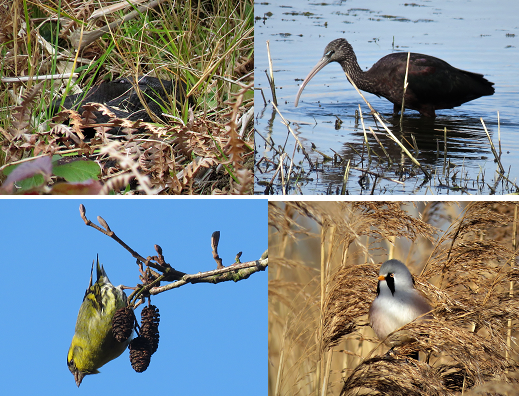
Black Adder & Glossy Ibis (March 12th)
Siskin & Bearded Tit (March 14th)

The hides around the scrapes provided views of displaying lapwings, black-tailed godwits, marsh harriers, pintails, wigeon, teal, shovelers, shelducks, avocets, dunlin and Mediterranean gulls. The walk to and along the beach had some interesting encounters including a toad, bearded tits, Cetti's warblers and a wheatear, which was hopping on the ground close behind some WW2 tank traps (or dragon teeth as they are also known as).

At the sluice gate, Mum decided to continue onwards to the visitor centre, while Dad and I went to look for two scarce birds in the area. First was a glossy ibis that was feeding in a pool near the pony paddock. Many people were watching from the gate on the reserve, but Dad and I followed a different path to the side of this pool and got really close views of the bird. I got a few good photos of it before it flew off, which I hope wasn't our doing. 

The other bird I wanted to see was the lesser yellowlegs, which was further up the beach towards Sizewell nuclear plant in a few pools known as the 'Lucky Pools'. They weren't so lucky for me as I wasn't able to find this American equivalent of a redshank but with yellow legs. I wish I brought my scope, as you really needed one to look for it and even then, it was like looking for a needle in a haystack. However, I did see some barnacle geese flying in and some stonechats sitting on the gorse bushes around me.

After meeting up with Mum for a late lunch at the visitor centre, we walked over to Island Mere Hide via the hill Springwatch was once based years ago. The hide was full of people, but was able to find a seat in time to see 2 bitterns fly around together before looping back round and landing into the reeds. I also saw a sleeping snipe, marsh harriers, and two great crested grebes. Feeling tired and my back killing me, we decided to skip Bittern Hide and head back to the car, where we had a send off from a muntjac deer, rabbits, pheasants and magpies.

March 14th Strumpshaw Fen

A really sunny second Monday shift at Strumpshaw and the place was alive with bird song, which included chiffchaffs, bullfinches and siskins. Fen Hide was a bit uneventful other than a heron, a Chinese water deer and marsh harriers being there. I did hear bearded tits pinging from the hide, but moving on to the top of Sandy Wall, I actually had quite an encounter with seven of these small birds and managed to get a few amazing photos of them posing atop of the reed heads in the brilliant sunlight.

Reception Hide was very quiet with barely anything to look at on the broad. Low flying marsh harriers was as good as it got. So I went for a quick walk around the woods and found treecreepers, the colony of Clarke's mining bees again, a brimstone and some queen bumblebees. Sadly, I missed out on a woodcock that apparently flew pass the Reception Hide before I arrived back from my pre-shift walk due to being spooked from the chainsaw work going on by the reserve's entrance that morning.

March 19th Strumpshaw Fen

It was a Saturday and I really wanted to go to Strumpshaw to see a duck. Garganey have returned from their migration from Africa and at least two were at the reserve. From my experience, they usually hang around a few days before moving off. So here I was at Strumpshaw just in case they disappeared by my latest shift on Monday. 

On arrival, I went straight to Tower Hide. They were still there! A male and a female. However, they were fast asleep with heads under wing. They did wake up briefly after being startled by something, but the photos were distant and a bit rubbish.

After returning for a lunch and toilet break, I decided to give the garganey another chance and walked all the way back to Tower Hide. This time, they were fully awake AND close to the front of the hide! Both together! I couldn't ask for anything better. The male was utterly stunning and the female, while no where near as showy, was subtly beautiful in her own way. The male was even croaking, a sound he uses to impress her and something I haven't heard in ages.

Garganey (March 19th)
Sanderling, Brambling 
& Meadow Pipit (March 27th) & dewy spider web (March 28th)

Also seen that day included; 5 redshanks, shelducks, 2 low flying buzzards soaring above my head, marsh harriers, a little grebe, a lizard, small tortoiseshells, red admirals, commas, peacocks and bee-fly.

March 21st Strumpshaw Fen

I returned to Strumpshaw, this time for my shift, my 3rd for a Monday and I went straight to Tower Hide. It was a frosty start, but that made the view that much more spectacular. And, I was happy to say that the garganey were still here, though sleeping once again. A goose did wake them up to move, but they went back to sleep almost instantly. As I waited for them to stir again, sound of a booming bittern shook the sleepy, misty atmosphere of the scene only slightly for a brief moment. 

Back at Reception Hide, it was much warmer and became a very nice day. On the wildlife side, the broad outside the hide wasn't producing much, a fairly quiet scene. But then, it suddenly erupted into life as three cranes circled high above the reserve, announcing themselves with their loud bugling calls. As soon as the cranes left, a grass snake was seen swimming in front of the hide, but I wasn't quick enough and missed it as it vanished into a reedbed.

March 27th Titchwell

It was Mother's Day in the UK and what better place to spend the day with Mum (and Dad) than at Titchwell. It was a really nice day, though there were some misty spells. There were plenty of birds around too, starting with a flock of brambling on the bird tables behind the visitor centre.

Out on the reserve, I felt like a bird guide as I not only pointed out the many species out on the reserve to my parents but also to two other visitors and their dog. Throughout my walk, the list of bird names grew and grew. Marsh harriers, red kite, avocets, brent geese, Canada geese, greylags, teal, shovelers, shelducks, gadwall, pochards, golden plover, displaying meadow pipits performing their parachuting song flights, Mediterranean gulls, tufted ducks, linnets, little egrets, wigeon, black-tailed godwits, little grebe, oystercatchers, skylarks, turnstones, redshanks and buzzards. An impressive bird haul, but I also added a toad as well, which sat by the side of the main path as we made our way towards the beach.

While I was here, I wanted to boost my own bird list that I've been doing since January. So far I had 115 before our visit here and I really wanted 5 more before the end of the month. I've already got all the birds mentioned above and I didn't get to add anything new until I reached the beach. The tide was in, so my hope of any exposure to the rich smorgasbord that the seaweed covered rocks provide for many hungry waders was dashed. However, I still managed to tick off sanderlings that were trotting along the shoreline like little wind-up toys. As we made our way back, I spotted some knot and then, from the Parrinder Hide, a pair of little ringed plovers and a rock pipit. I ended my visit with 119, just one bird short of my monthly target!

March 28th Strumpshaw Fen

It was feeling like it was changing back to winter. It wasn't as warm as it has been all month and it was very murky with a thick mist covering the landscape. First thing on my agenda was to go check if the garganey were still around at Tower Hide. I started to make my way there, however, as I reached as far as the sluice gates when I heard a familiar croaking sound. I looked over the Accidental Broad and there they were! Two males and one female! Seeing them here saved me the journey, so I turned back without going any further. As I turned the corner back onto the Sandy Wall, I encountered a small flock of bearded tits close to the path. I also had some in front of Reception Hide with the sun burning its way through the mist revealing bluer skies and warm sunshine.

With no other free days to birdwatch, this was realistically my last chance to really get my 120th bird before March ended. And I'm pleased to say that I reached my goal. In the woods, by Basecamp, I heard my first blackcap of the year. It didn't show itself very well, only glimpses, but it was better than nothing. Just hearing it was enough for me.

There was a moment of excitement as I was about to leave for home as news arrived of a white-tailed eagle was seen flying over Surlingham and was heading this way to Strumpshaw! Alas, there was no sign of it and I had to leave. What a tick for my 121st bird that would have been!

Monday, 28 February 2022

Storming To 100 Birds

Feb 1st Whitlingham Broad

Fed up of waiting around for a shift at my postal sorting job, I wanted to go out for some fresh air and a walk around Whitlingham Broad. My Mum kindly dropped me off this afternoon and I went off to look for new birds to add to my year list. It was a pleasant day for it, though quite blustery, which would set the theme for the rest of the month. Despite the windy conditions, there were plenty of birds about. On the broad were large numbers of gadwall, tufted ducks, coots, mallards and the odd pochard. Meanwhile, by the barn car park, a couple brought a tub of seed with them and all the swans, geese (greylags, Egyptian and the local barnacle), ducks and gulls (black-headed, common and lesser black-backed mostly) quickly surrounded them in an instant.

Making my round the broad, a kestrel braved over the choppy waters and attempted to hunt the wildfowl for some reason before thinking twice about it and left. Further along, I spotted a few distant male goldeneye. Their white cheek patches were very visible and helped distinguish them even from as far off as they were. Returning back to the spot where the couple were feeding the ducks, etc, the light was beginning to fade and I managed to find the male mandarin that must have just arrived to roost and was already dozing off. Also seen during my visit were; shovelers, cormorants, one great crested grebe and a very distant and high soaring sparrowhawk.

Mandarin Duck (Feb 1st), Flood damage (Feb 2nd) & Snowdrops (Feb 9th)

Feb 2nd Strumpshaw Fen

On the final weekend of January, I discovered some news from Strumpshaw that, due to Storm Malik, the reserve recorded its worst ever flood since the RSPB took over over 45 years ago. The River Yare rose to 1.40m and most of Strumpshaw's paths were underwater and closed off.

On my arrival for my latest shift a few days later, I feared for the worst. The road beside the car park was a shallow stream and didn't give me much confidence. But, thankfully, it wasn't too bad. I managed to walk around most of the reserve with no problem and the flood had subsided greatly. The paths leading to Fen and Tower hides remained underwater and out of bounds, the only areas in which were still badly effected. The woodland trail and the Reception Hide were the places to be with great spotted woodpeckers, Chinese water deer, Muntjac deer, marsh harriers, siskins, gadwall, shovelers, mallards (including a white one), greylags, mute swans, herons, teal, scarlet elfcap fungus and snowdrops.

Feb 8th Catton Park

A short visit to my local park. Highlights being 2 buzzards, 4 stock doves and a great spotted woodpecker.

Feb 9th Strumpshaw Fen

A much drier walk at Strumpshaw as the flood had subsided to normal levels. The Fen Hide was open again, but there wasn't much to see other than 3 Chinese water deer and a couple of marsh harriers. During my morning walk, I witnessed hundreds of pink-footed geese fill the sky with skein after skein, 10 snipe flying into the meadows, siskins, redwings, and, near Base Camp, the small display of snowdrops were now at their best. At Reception Hide, the broad was full of greylags, gadwall, a few mallards, shovelers and coot, in which one pair was building a nest.

Feb 10th Kelling Quags & Cley

Dad and I went in search of the red-breasted goose that was spending time with the brent geese at Cley. Along the way, we stopped at Kelling Quags. Here, we had a field full with pink-footed geese (but no sign of the tundra bean geese that were apparently amongst them), wigeon, shovelers, red-legged partridges and great black-backed gulls.

After a stop at the Kelling tea rooms, we made our way to Cley. On the drive up, we noticed many people looking at something from East Bank. Sadly, there was nowhere to park, so we continued to the beach where I was hoping to see the red-breasted goose. However, there was no sign of anything. We had a quick scan around at the blind overlooking the pools from the beach side, where many brent geese were, but not the goose I wanted. There were a few pintails, teal, wigeon, shovelers and a curlew as well and we came across a stonechat and skylarks on the return to the car.

Pink-footed Geese (Feb 10th), Scarlet Elfcaps (Feb 16th)
Storm damage, Song Thrush,
Peacock & Marsh Harrier (Feb 23rd)

At the visitor centre, I learned that the goose was indeed at the East Bank and had since flown east. I had missed my chance! Though I had failed to see it, we had a quick look along East Bank anyway and I added little egrets, grey plover, ringed plovers, oystercatchers and turnstones to my bird list and it took me to 101 species!

Feb 13th Sheringham

I had the opportunity to go sea watching at Sheringham before the latest storm arrived. While my parents went into town, I was left at a shelter with my scope to scan the sea for an hour. The sea seemed flat and calm and empty with just a few gulls and the odd seal, but once I had my eye in, I managed to spot a few distant gannets, red-throated divers and one guillemot.

Once my hour was up, I had a quick look around for purple sandpipers, but could only find turnstones, many of them. At times, these turnstones came up to my feet!

Feb 16th Strumpshaw Fen

A very windy morning, but still relatively warm. Despite the strong winds, I still saw a few good things. At Fen Hide, there was a heron, a snipe, 2 mute swans, greylags, and marsh harriers. The woods, meanwhile, were a deafening place due to the raucous twittering of siskins as well as treecreepers, nuthatches, song thrushes, marsh tits and other common woodland birds minus the woodpeckers. Scarlet elfcap fungi were everywhere on the ground and were more vivid than ever thanks to the perfect light conditions.

It was a bit quieter at Reception hide, but at the end of my shift, provided me with the big highlight of the day in the form of two red kites. With their long wings and distinctive forked tails, it made them easier to identify over the buzzards and marsh harriers that were also around. Other than that, there were 14 coots, about 10+ greylags, a couple of Canada geese and 2 more mute swans.

Feb 20th Buckenham Marshes

Two days after Storm Eunice battered the country, the most dangerous storm in a long, long time, Dad and I decided that we go for a short walk at Buckenham for a couple of hours. We must have been out of our minds. It was another stormy day with Franklin blowing a gale, the third storm in a week! Though not quite as powerful as Eunice, it still wasn't the best conditions to be in. It was more of the rain than the strong winds that really got to us in the end, though, as we were absolutely soaking!

Despite the storm, there was still plenty to see. Marsh harriers were braving the howling gales to attempt to hunt and helped us out in seeing everything that was possibly on the marshes as everything flew up into the dangerous stormy sky to escape becoming a snack. Hundreds of them. Wigeon, lapwing, golden plover and starling were up there swirling around like flakes in a snow globe that's been shook up.

Feb 23rd Strumpshaw Fen

Damage caused by Strom Eunice was still evident to see when I arrived at Strumpshaw for my last shift for February. The ivy covered tree that was standing near Reception Hide was one of several trees that was toppled over and remained on the ground. Good thing it didn't fall in the opposite direction. Thankfully, all the hides and facilities survived the storm without a scratch. 

A big flood had also occurred the day before this shift and had forced Fen Hide and Tower Hide to close. I went to check out the latest conditions and was able to get to Fen Hide with no problem, enough for the sign for closure to be removed. Not that there was much to see, however. 

There was a lot more activity in the woods as the birds were full of song, which included the voices of song and mistle thrushes, hundreds of siskins and I also encountered 2 treecreepers spiralling up a tree. It was a lovely day, so much so that I saw my first butterfly of the year, a peacock which sunned itself next to the fallen ivy tree. What made my day, though, was a red kite which flew low over my head and over the broad in front of Reception Hide. Sadly, I left my camera inside the hide, a very foolish mistake!

Monday, 31 January 2022

New Year, New Bird

 Jan 3rd Cley

My first outing of 2022 and it was a trip to Cley with my parents. This year, I wanted to photograph as many birds I've haven't got a decent photo of yet and there happened to be one at Cley. An Iceland gull had been hanging around the reserve for most of the winter, but I've yet to find it. This pale brown-white juvenile gull is part of a species that's not only new for me to photograph, but also for me in general. Iceland gulls have been eluding me for years and I was really hoping to scratch it off my bucket list once and for all.

This winter visitor, the size of a herring gull but paler, was apparently seen somewhere on the beach. I was tipped off that it was near the East Bank side of the reserve, so that's where I started my search first. Once I reached the shelter at the far end of the East Bank and after a quick scan, I managed to spot the gull feeding on a dead seal pup on the shingled ridge along the beach from afar. A few minutes later and I was able to not only reach the bird, but to get extremely close to it without spooking it. The gull was so focused on feeding that it wasn't interested in us at all and I got many photos. It may only be a gull, but I was so happy to have seen one at long last. Though I was a tad sad for the dead seal.

Iceland Gull (Jan 3rd), Shag (Jan 9th)
Frosty scene & Bittern (Jan 12th)

A view from East Bank and a visit to the central hides revealed wigeon, teal, shovelers, shelducks, marsh harriers, curlews, redshanks, dunlins, lapwings, brent geese, pink-footed geese, black-headed gulls, black-tailed godwits, avocets, ruff, herring gulls, linnets and heard a skylark. Not a bad haul to start my 2022 bird list with.

Jan 5th Strumpshaw Fen

The first shift at Strumpshaw 2022 and it was definitely eventful. It was very frosty and I managed to slip over on the way to the reserve. Then on arrival, I discovered that half the reserve was flooded. I couldn't even get to Fen Hide let alone to Tower Hide With both hides out of the question, I was forced to walk to the pumphouse and the woods. Not the best of walks as it was a bit muddy. The woods were far more productive than anywhere else with siskins, redwings and a muntjac deer.

At Reception Hide, it was fairly windy and cold and, for the most part, empty with bird life besides a few gadwall, marsh harriers and 2 mute swans. But then an otter appeared and made things more exciting for half an hour. It spent most of the time hunting, diving and pouncing in the broad until it swam out of sight down the far left channel. Also seen today: a great spotted woodpecker, 4 shelducks, a kestrel, buzzards, a heron, a song thrush and marsh tits.

Jan 9th Whitlingham Broad

I heard that a shag was hanging around Whitlingham Broad recently. Kind of an odd bird to be seen this close to Norwich as this smaller cousin of the cormorant is normally a sea bird. I was very curious so I went to have a look.

From the car park, I walked counter-clockwise around the Great Broad and it didn't take long until I found the bird I was looking for. It was sitting on the floating nesting platform with a cormorant and 3 juvenile gulls. Thanks to the cormorant being there, I was able make the comparisons. The shag is slightly shorter, has a rounder head and looks smaller overall (shorter bill, etc). I was really surprised that I was able to identify it so easily and find it so quickly.

Also seen were; large numbers of tufted ducks and coots, gadwall, moorhens, greylags, Egyptian geese, mallards, a feral barnacle goose, a grey heron, calling buzzards, shovelers, common gulls and black-headed gulls.

Jan 12th Strumpshaw Fen, Buckenham Marshes, Martham, Ludham & Hickling Broad/Stubbs Mill

This was to be a long day and I almost missed part of it due to my phone failing to wake me up! Thankfully and gratefully, Mum gave me a lift to Strumpshaw early enough that I still had time for my morning walk there before my shift started. Though I did hear some bearded tits, all I saw was a beautiful frosty landscape.

During my shift at Reception Hide, there were plenty of ducks on the broad, mostly mallards, gadwall, shovelers and a few teal, greylags and 3 coots. The real highlight though was a bittern flying from the reed bed on my near left to land in full view in the reed islands and later showed itself properly in the open in the strimmed section of the islands before flying off.

At the end of my shift, I began an afternoon bird tour with my Reception Hide colleague, Tricia. Starting at Buckenham for the Taiga bean geese, but failed to find any. We did, however drove past a hare along the way here.

Next up was a field in Martham. Here, we found a couple of cattle egrets following some cows and sheep that were grazing in this field. They were fairly close and were fully invested in what the livestock were disturbing than on us being on the other side of the fence.

Cattle Egret, Whooper & Bewick's Swans
Cranes & Sunset (Jan 12th)

A short drive later, we arrived to Ludham airfield in which a large gathering of swans were grazing. They mostly Bewick's (possibly 50+) with about 10 much larger whooper swans. Always a treat to see these beautiful winter swans while small aircraft flew by them all.

After seeing a second hare by the roadside while back on the road, we reached our final stop on our tour. We arrived at Hickling Broad in time before the main event could begin. Tricia wanted us to experience the raptor roost at Stubb's Mill together. There was a bit of a long, muddy walk to the mill, but had some good views of the flooded pools full of wildfowl along the way. Once we got to the viewing platform, we found a spot amongst the many others armed with scopes, binoculars and cameras and waited for the sun to set.

While the sky glowed into reds and golds behind us, we watched the marsh harriers come into roost in the field in front of us that was gradually fading into darkness with every passing minute. There was possibly 30+ harriers, but I wasn't really counting. I was busy scanning for a much rarer cousin, a hen harrier. With the last bit of light, I managed to glimpse the light grey of a male with it's jet black wingtips just visible before the bird vanished within some reeds. Unfortunately, the light was too poor and the sighting was so brief that I was unable to get that photo for my bucket list.

Not only did we see the hen harrier and the many marsh harriers, we also had 9 cranes fly over towards their roost site and we heard a tawny owl hoot. It was a great end to a great day of bird watching. My only regret was not getting that photo of the hen harrier like I was hoping for.

Jan 13th Catton Park

Walking round my local park, I heard drumming great spotted woodpeckers, a nuthatch and stock doves in the woods. I then found a buzzard in a tree that then dived down in front of a shrub and caught a vole before landing in a different tree to feast on it. A moment later, 4 fieldfare surprised me by flying over my head to land in the same tree the buzzard was in previously. The low sun was right in my eyes to see them properly and they flew off before I could move into a better position. This was the first time I've seen fieldfares at this park.

Jan 19th Strumpshaw Fen

A fairly quiet morning at Strumpshaw. Fen Hide produced only a few marsh harriers and 3-4 Chinese water deer, while at Reception Hide had 10 coots (first time in a long while), a few gadwall, mallards and greylags. The feeders outside attracted a great spotted woodpecker and 2 collared doves, which is a surprising rarity at the reserve as I don't see them here that often. When I got back into Norwich, I could see a peregrine falcon on the top of the spire of the cathedral as I waited for a bus home.

Jan 21st Sculthorpe Moor

I went with Dad to check out the new changes at Sculthorpe. There's a new path route into the reserve and one of two new hides open with the other to be open later this year. There was a bit of work going on during our visit, promising some exciting further changes to this fairly young reserve. The new changes that were available now were a mix bag. The new path was a far better way in than the country road that was the main way in before. The new hide, on the other hand, still needs some work. The windows were too small for my liking and the view seemed to be still in development.

The real interesting stuff were on the main, original area of the reserve. From the blind overlooking some feeders produced a bank vole, siskins, bramblings and the first of many bullfinches of the day. The Woodland Hide was also very productive with 2 muntjac deer, a great spotted woodpecker, a pheasant, greenfinches, blackbirds, dunnocks, robins, chaffinches, blue and great tits and redwings (in the trees above).

Moon & Sunrise (Jan 19th) Brambling,
Bullfinch, Muntjac Deer
& Long-tailed Tit (Jan 21st), White Chaffinch (Jan 29th)

On the way to the next hide, a red kite was flying over a treeline where a buzzard was sitting in. We then had lunch inside Whitley Hide while watching 4 muntjacs (one being a young fawn), 3-4 pheasants, several collared doves, a female reed bunting, mallards and 2 grey squirrels as well as the usual common birds such as robins, chaffinches, etc, all feeding from or under the 2 bird tables. The Canopy Hide is possibly our favourite hide with its bird table close to the window and attracting about 10+ species, including nuthatches, bullfinches, long-tailed tits, a marsh tit and a male reed bunting. 

The final 2 hides didn't provide us much to see, except a red kite and some very distant lapwings in a field. We went back to 2 of the previous hides for one last look over before heading back to the car, seeing a mistle thrush in the trees bordering the car park. It was a great visit, leaving us with a large list of species. If you want somewhere to get very close to bullfinches, this is THE place!

Jan 26th Strumpshaw

A large flock of perhaps 100 or so siskins welcomed me on the way to Strumpshaw as the trees were alive with a cacophony of twittering that blended together into quite a din. Then they erupted into the air and circled above my head into an incredible sight. Not the first group of birds to do so that morning as a little earlier on the way from Brundall, thousands of rooks and jackdaws also did the same as they streamed over me from their roost site in Buckenham.


Other than that, the rest of the morning wasn't as eventful. There were 2 mute swans, marsh harriers and a Chinese water deer and heard some pinging bearded tits at Fen Hide and to add to that, 20 or so gadwall, 10+ coots, 6 greylags and a few mallards at Reception Hide and that was as good as it got. It was such a freezing, cold morning that I just couldn't wait to get back home and warm up.

Jan 29th Waterloo Park

The RSPB's Big Garden Bird Watch weekend has returned for its 53rd year in which you spend an hour watching your garden and record the birds that appear in that hour. I don't have a garden myself, so I went to my local park to help out with an event that was promoting this annual survey. The Friends of Waterloo Park and the RSPB has joined forces and set up several stalls at the centre of the park. I was helping out at the RSPB gazebo overlooking some trees full of bird feeders. 

The feeders were attracting many birds. A lot of them being finches. Greenfinches and goldfinches were well represented here. However, the star bird was a leucistic chaffinch. An unusually white chaffinch. It was so white that the local residents living nearby were mistaking it for a snow bunting. Every time it showed up, it really stood out like a sore thumb. It was a very beautiful individual.

Jan 30th Norwich

As I didn't have a garden myself, I walked over to my parent's house to do the survey instead. They were away for the weekend, so I had the place to myself. There were more birds outside their garden than in it, but between 9:42 and 10:42 I recorded 4 blackbirds, 1 blue tit, 1 robin, 1 woodpigeon and 1 dunnock.

Tuesday, 4 January 2022

My Bird Bucket List Challenge 2022

Two years ago, I was trying to do a challenge in which I wanted to photograph as many species of bird that I've never gotten a photo of before. Due to the lockdowns, that challenge was sadly cut short. It started well too as I managed to get a photo of a tawny owl in the day at Ipswich and a great grey shrike in the Forest of Dean just to name a few. A few extras have been added since then, of course. However, I want this year to be the one I really have a good go in finding some others to my photo collection book that I have made for myself. I have started this challenge already with an Iceland gull at Cley (you can read all about it later this month) and this has me hyped into finding more new birds.

So, what is on my bucket list? Which birds do I still need a photo of? Well, let's have a look...
Black-throated diver 
Great northern diver
Sooty, Balearic & Cory's shearwaters
Leach's petrel
Storm petrel
Black guillemot
Little auk
Roseate tern 
Black tern
Arctic skua
Pomarine skua
Long-tailed skua
Great skua (basically all the sea birds as I find them tough to photograph)
Dotterel
Red-necked phalarope
Woodcock (during the day)
Quail
Long-eared owl
Nightjar
Hen harrier
Montagu's harrier
Goshawk
Merlin
Lesser spotted woodpecker
Ring ouzel 
Nightingale
Lesser whitethroat
Wood warbler
Yellow-browed warbler
Pied flycatcher
Willow tit
Not only this but also any rare migrants that may show up.

I want at least one decent photo of any these birds a month. It would be impressive to get all of them, but I'll be more satisfied if I'd get just a few of them. If you want to help me out, let me know. I've also got something big planned in May if things go to plan which will definitely boost my list with birds not even on this list. Finger's crossed we don't get any more lockdowns or any other bad thing that could possibly force me to abandon this challenge like in 2020.

Friday, 31 December 2021

The End Of A Tough Year

 Dec 1st Strumpshaw Fen

It was a very windy start to December. It seemed everything was hunkering down for safety as there wasn't a lot around at all. Marsh harriers, the odd buzzard, a few mallards and a pair of swan were the only things brave enough to be seen from Reception Hide. The feeders were more busier with marsh tits among all the usual suspects braving the strong gusts to feed. Other than that, it was a rubbish day.

Dec 4th Cley

There was a gap in the wet weather to go out to Cley for a spot of sea watching. That afternoon, Mum dropped me off at the beach and left me to it for a while. For some time, I was the only person with a scope at the beach shelter as I attempted to find something interesting on my own as a short spell of rain occurred. I found some large-ish guillemot like things far out at sea, but I wasn't confident enough to turn them into anything else. Looking back at my dodgy distant and blurry photos back at the comfort of my home much later on, I discovered one was a puffin! The photo wasn't worth keeping, but I could see a white roundish head with a few pixels that resembled a red bill. Nothing else it could have been!

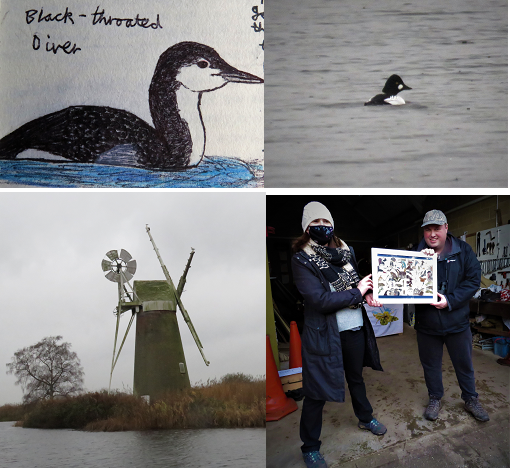
Thankfully, some expert sea watchers did arrive and they helped me find, not just a Caspian gull, but also my first ever black-throated diver! It was tricky to look at, let alone photograph, as it kept diving so much around the area of the old ship wreck that now protrudes from the surface. It was the size of the several cormorants that were nearby and much blacker than a red-throated diver, but with white sides that were just visible over the bobbing waves. A great bird, though I could only manage one photo of it and it was terrible. I wish I could get a better photo of one some day. Also seen were guillemots, razorbill, turnstones, wigeon, brent geese, great black-backed, herring, common and black-headed gulls and a grey seal. In the end of the day, my tally grew to 161 bird species.

Black-throated Diver (Dec 4th), Goldeneye & How Hill Windmill (Dec 6th)
and me presenting my drawing (Dec 10th) 

Dec 6th Barton Broad & River Ant

I had a nice surprise during my previous shift at Strumpshaw as my Reception Hide colleague, Tricia, invited me to a boat trip. I travelled to Wroxham by train to meet up with her, who then drove me to the boat that we and Tricia's co-driver were going to take me on an afternoon's ride around Barton Broad and up the River Ant as far as How Hill before heading back to base. However, the weather was horrendous, but thankfully this was an enclosed electric boat, so at least I was going to be dry.

Tricia started the engine and made our way to Barton Broad, before her co-driver took over the wheel. On the broad, we counted around 30 goldeneyes, which were very skittish and difficult to photograph in the bad weather and light conditions while on a moving boat. I did, however, witness a few males display to the females by flipping their head onto their backs. We also saw tufted ducks, herons, great crested grebes, cormorants and mute swans and, along the River Ant, 2 little grebes. It was an interesting ride, despite the relentless torrential downpour. Unfortunately, I left the boat with a bump as I slipped over on the unusually steep metal gangplank and I fell onto my backside! OUCH!

Dec 8th Strumpshaw Fen

Strong winds again! Nothing much to see, again! I served more coffees than birds seen this morning. I did see the odd siskin in the woods, the usual birds on the feeders, a buzzard and a few marsh harriers braving these blustery conditions and 4 mallards and a teal in front of Reception Hide as well as a flock of greylags and a cormorant in the distance and a kestrel on the walk back to Brundall station. In the end, nothing much to get excited about.

Dec 10th Mousehold Heath & Strumpshaw Fen

It was to be a busy day. First was a food shop. Then was the first of two walks starting at Mousehold in the morning. I joined Will, Peter and their group of two others for a short walk around the heath to look for birds and just to catch up on things. Coal tits, magpies, a couple of common gulls and the usual blue, great and long-tailed tits, chaffinches, etc made up the list before heading back for lunch. I didn't stay, however, I had to get to my second walk at Strumpshaw.

Mum picked me up and dropped me off at the reserve before the walk even began. This was a short walk to the river and back with the large group of staff and volunteers. We didn't really see that much, but it wasn't really about seeing wildlife, it was about having a get together with everyone involved with Strumpshaw. This was the first Christmas gathering for two years now and after the walk, we listened to what had happened this year behind the scenes on the reserve. And I showed everyone my gift that I made for Strumpshaw, a drawing of the wildlife I've seen over the past 10 years since I've volunteered here and to celebrate 45 years of the reserve since the RSPB took it over. It was well received by everyone. I was so pleased as it took a few months to do.

Dec 15th Strumpshaw Fen

A fairly warm and lovely day for December. From Fen Hide, I had a very brief otter appearance, arriving from the left and vanishing from the left within a few seconds. From Reception Hide, there was a brief bearded tit sighting, while the marsh harriers and buzzards circled the sky, two of each. I also saw siskins, pink-footed geese, mallard, gadwall and, at the end of my shift, a great spotted woodpecker was on the feeders.

Dec 19th R.I.P Grandad (Rex Blyth) 1934- 2021

With just a week to go before Christmas, I woke up this morning to some very sad news. My grandad had passed away aged 87. He wasn't exactly a bird watcher or anything, but he would always support my interest in wildlife and always asked me what I've seen lately.

I remember back in 2003 after graduating from school, I spent a week with my grandparents and they took me around the county in their campervan. One evening, we were driving back from somewhere and we came across a barn owl flying over a field. I can remember how pleased they were at the time as it was probably the first time they've experienced a wildlife encounter like that with me. Later that week, Grandad took me for a walk along Blakney Harbour, the only time we ever bird watched together just me and him. At the time, I believe we glimpsed a black redstart on the beach and we had a sedge warbler singing right by our feet.

Years later, during a visit to my grandparent's house, I was watching the birds on his feeders. Suddenly a brambling appeared from nowhere and I recall Grandad being delighted as he never even heard of such a bird and would have passed it for just a chaffinch if it wasn't for me. These moments of me, him and encounters with wildlife were rare and few and far between, but I will never forget them.

Dec 22nd Strumpshaw Fen

It was a beautiful frosty morning, my last shift before Christmas. Haw frost covered everything and transformed the vegetation into ice-covered sculptures. It was like a winter wonderland. Even the reserve's Highland cattle were covered in frost and looking like a festive image that deserves to be on the front of a Christmas card before I watched Strumpshaw warden Matt and his team moved them onto another pasture. It was pretty much a morning I needed to reflect on things after Grandad passed away. I was more admiring the frost than finding wildlife. However, I did manage to find siskins, a muntjac deer, a great crested grebe, pink-footed geese and Canada geese.

Great Spotted Woodpecker (Dec 15th),
Frost on Oak leaves, Burdock & Highland Cow (Dec 22nd)
Robin (Dec 22nd) And Tufted Ducks (Dec 29th)

The Reception Hide was a chilly place even with the heaters on. My toes were numb by the end of my shift. It was freezing! Most of the broad was frozen apart from the area around the reedy islands and at the back of the broad, in which attracted a large number of mallards, gadwall, shovelers and teal, 2 mute swans and the odd marsh harrier and buzzard. A really beautiful day, but too cold for me!

Dec 29th Strumpshaw Fen

My final shift of 2021 was a miserable one as it was raining. On the plus side, it wasn't very cold like last week, just dull, grey and on the damp side of things. The ducks didn't seem to mind at least. The broad was absolutely full of gadwall, mallard and greylag geese with around 10 teal and 10 shovelers and a pair of tufted ducks and mute swans as well as my first coot outside Reception Hide for a long while. I'm pleased in the coot because they usually over winter here at Strumpshaw in large numbers, since last winter, however, I haven't seen many at all. I was quite concerned.

Also seen today were marsh harriers and buzzards, a flock of lapwing flying by and, to round up the year nicely was an otter! It spooked everything off the broad while busy hunting behind the reedy island area, being very tricky to follow its every move.

Dec 31st Mousehold Heath

My 12 and final dawn chorus of the year on the final day of the year and I decided to do it at Mousehold. I arrived just before 7am, while it was still dark, listening to the robins, wrens, alarm calling blackbirds, cawing crows and a song thrush. It all seemed too promising. On the walk up, it was dry, a bit muddy underfoot, but no rain in sight. That is, until I sat down to get my camera out. It wasn't too bad at first, short on and off outbursts that didn't last for that long. However, it all changed to a heavy downpour and I was getting soaked in an instant. I had to abandon my walk and leave for home as soon as possible. Typical that while writing this, the rain has gone and it's now a lovely, sunny day! 

What a way to end my 2021 dawn chorus challenge. And what a way to end 2021 as a whole. It has been a very challenging year. Covid has yet again made it a very rubbish-y year, though, for at least the first 6 months, I was actually enjoying myself finding as many birds as I could within or just a few miles from the city whilst in lockdown. I had a lot more freedom than I did for the majority of 2020, but I felt the latter 6 months of 2021 to be the hardest. Especially now with my grandad passing away just before Christmas. It has been extremely tough. I can only hope that 2022 surpasses 2020 and 2021 combined. I haven't even planned what challenge I want to do for next year yet, but I will keep you posted. Happy New Year everyone!

Thursday, 30 December 2021

My Final Bird List 2021

Back in January, the 3rd lockdown had me bored out of my mind. I was craving to go out and look for birds. So I decided to do a year list. Something that I don't really do. Up until mid-spring, I kept it local, finding as many bird species in and around Norwich as far out as Whitlingham and Thorpe Marshes. To my surprise, I managed to build quite a respectable list which included some very unusual findings such as a white-fronted goose, a black redstart, ring-necked parakeets and a couple of curlew. 

By summer, I had a lot more freedom to travel much further afield and my list included some very exciting rarities such as a roller and a western sandpiper. However, by August, my list was grinding to a halt and my interest in the list was being replaced by other projects. I was spending less time throughout the autumn months going out and more time at home drawing. I was more interest getting these drawing projects done, that I missed out on a lot of the migrants that were coming in. There were a few family related things cropping up too, so it was becoming rare to organise a trip out to birdwatch. Despite all of this though, my list has totalled to 161 species. If weather, my drawing projects and family matters didn't restrict me as much as it did, I'm sure I would had reached the 200 mark no doubt about it.

Here is what has made it to my list...
(I will include more details on my highlight species that made my year)
  1. Mute Swan 
  2. Pink-footed Goose 
  3. White-fronted Goose (Marston Marshes 7/3/2021)
  4. Greylag Goose
  5. Canada Goose
  6. Barnacle Goose (Feral individual at Whitlingham Broad)
  7. Brent Goose 
  8. Egyptian Goose
  9. Shelduck
  10. Mandarin (Whitlingham Broad 5/4/2021)
  11. Wigeon
  12. Gadwall
  13. Teal
  14. Mallard
  15. Pintail
  16. Garganey (Strumpshaw Fen 4/8/2021)
  17. Shoveler
  18. Pochard
  19. Tufted Duck
  20. Scaup (Whitlingham Broad 6/2/2021)
  21. Common Scoter
  22. Goldeneye
  23. Smew (Whitlingham Broad 13/2/2021)
  24. Red-breasted Merganser (Cley 10/10/2021)
  25. Red-legged Partridge
  26. Pheasant
  27. Red-throated Diver
  28. Black-throated Diver (Cley 4/12/2021)
  29. Fulmar (Sheringham 5/9/2021)
  30. Manx Shearwater (Cley 10/10/2021)
  31. Little Grebe
  32. Great Crested Grebe
  33. Spoonbill (Cley 11/4/2021)
  34. Bittern (Strumpshaw Fen 9/6/2021)
  35. Grey Heron
  36. Great White Egret (Strumpshaw Fen 12/5/2021)
  37. Little Egret
  38. Gannet
  39. Cormorant
  40. Red Kite (Over my flat! 17/3/2021)
  41. Marsh Harrier
  42. Sparrowhawk
  43. Buzzard
  44. Kestrel
  45. Hobby
  46. Peregrine
  47. Water Rail
  48. Moorhen
  49. Coot
  50. Crane (Strumpshaw Fen 28/4/2021)
  51. Oystercatcher
  52. Avocet
  53. Ringed Plover
  54. Golden Plover
  55. Grey Plover
  56. Lapwing
  57. Knot
  58. Sanderling
  59. Little Stint
  60. Western Sandpiper (Snettisham 29/7/2021)
  61. Curlew Sandpiper (Snettisham 29/7/2021)
  62. Dunlin
  63. Ruff
  64. Snipe
  65. Woodcock (Hellesdon Road, Norwich 14/2/2021)
  66. Black-tailed Godwit
  67. Bar-tailed Godwit
  68. Whimbrel (Cley 15/8/2021)
  69. Curlew
  70. Common Sandpiper
  71. Green Sandpiper
  72. Spotted Redshank
  73. Redshank
  74. Turnstone
  75. Kittiwake (Whitlingham Broad 5/4/2021)
  76. Black-headed Gull
  77. Little Gull (Thorpe Marshes 31/3/2021)
  78. Mediterranean Gull
  79. Common Gull
  80. Lesser Black-backed Gull
  81. Great Black-backed Gull
  82. Herring Gull
  83. Yellow-legged Gull (Wensum Park 28/1/2021)
  84. Caspian Gull (Cley 4/12/2021)
  85. Little Tern (Minsmere 5/7/2021)
  86. Sandwich Tern
  87. Common Tern
  88. Guillemot
  89. Razorbill
  90. Puffin (Cley 4/12/2021)
  91. Rock Dove/Feral Pigeon
  92. Stock Dove
  93. Woodpigeon
  94. Collared Dove
  95. Ring-necked Parakeet (Hellesdon Road 30/1/2021)
  96. Cuckoo (Thorpe Marshes 10/5/2021)
  97. Barn Owl (Sleeping in a tree, Whitlingham Broad 24/3/2021)
  98. Tawny Owl (Whitlingham Broad 2/5/2021)
  99. Swift
  100. Swallow
  101. Sand Martin
  102. House Martin
  103. Kingfisher (Whitlingham Broad 31/1/2021 but also plenty of times in Norwich)
  104. Roller (Icklingham 27/6/2021)
  105. Green Woodpecker
  106. Great Spotted Woodpecker
  107. Magpie
  108. Jay
  109. Jackdaw
  110. Rook
  111. Carrion Crow
  112. Blue Tit
  113. Great Tit
  114. Coal Tit
  115. Marsh Tit (Strumpshaw Fen 28/4/2021)
  116. Long-tailed Tit
  117. Bearded Tit (Titchwell 9/5/2021 but also Strumpshaw Fen plenty of times)
  118. Skylark
  119. Short-toed Lark (West Runton 6/11/2021)
  120. Cetti's Warbler
  121. Chiffchaff
  122. Willow Warbler
  123. Sedge Warbler
  124. Reed Warbler
  125. Grasshopper Warbler (Strumpshaw Fen 2/6/2021)
  126. Blackcap
  127. Garden Warbler (Whitlingham Broad 10/5/2021)
  128. Whitethroat
  129. Goldcrest
  130. Wren
  131. Nuthatch
  132. Treecreeper
  133. Starling
  134. Blackbird
  135. Fieldfare (Strumpshaw Fen 17/11/2021)
  136. Song Thrush
  137. Redwing
  138. Mistle Thrush
  139. Robin
  140. Black Redstart (Near my flat! 4/3/2021) 
  141. Redstart (Heard only at Nagshead, Forest of Dean 10/7/2021)
  142. Whinchat (Earlham Marshes 3/5/2021)
  143. Stonechat
  144. Wheatear (Cley 22/5/2021)
  145. Spotted Flycatcher (Strumpshaw Fen 12/5/2021)
  146. Dunnock
  147. Yellow Wagtail (Earlham Marshes 3/5/2021)
  148. Grey Wagtail (Norwich 29/3/2021)
  149. Pied Wagtail
  150. Meadow Pipit
  151. House Sparrow
  152. Chaffinch
  153. Greenfinch
  154. Goldfinch
  155. Siskin
  156. Linnet
  157. Lesser Redpoll (Whitlingham Broad 24/3/2021)
  158. Bullfinch
  159. Snow Bunting (Cley 6/11/2021)
  160. Reed Bunting
  161. Corn Bunting (Heard only near Choseley Barns 9/5/2021)

Wednesday, 15 December 2021

7 Years On & 10 At Strumpshaw Fen

 Can you believe it has been 7 years since I started this blog AND that's not all. 2021 marks 10 years since I became a volunteer at Strumpshaw Fen, which is silently celebrating its 45th year anniversary since the RSPB took the site on. To celebrate all of these milestones, over the past few months I have been working on a drawing project. Below is a 2 page drawing I have framed as a present to the reserve. In it includes only some (yes, some) of the many amazing wildlife encounters I have had at Strumpshaw over the past 10 years. Many of these species you can be sure to find yourself if you search hard enough or know where to look, while others were just chance encounters that are unlikely to occur again. 

So let me go through them all in no real order. First, the most important creature and the real reason that brought me into volunteering at Strumpshaw 10 years ago. It is the marsh harrier. At the time, I was in my mid-20's and I needed something to do. My parents got me to volunteer at the reserve in order to help them do a few marsh harrier surveys every Wednesday for about a month. From the Tower Hide, I joined Ben (Strumpshaw warden to this day) and two others to record the movements, behaviours and nest site locations of the harriers and it was like watching a soap opera, far better than any on TV. The more we watched, the more we learned about them.

Once the harrier survey season was over, I helped out with one bittern survey, which was actually very productive as we recorded the movements of at least 2-3 individuals. Stepping out from Tower Hide on that occasion left with a moment I will never forget. Walking back from the hide, I came across 2 men standing on a bench with a woman standing nearby trying to look over some reeds. I asked what they were doing and the reply was "Otters!" That led to me joining them on the bench and there I saw not just my first ever otter, but my first otter with a cub! 

When the harrier and bittern surveys ended, I was back without a thing to do and I really wanted to continue helping out at the reserve. So, I was asked if I wanted to help out at Reception Hide and I've been there every Wednesday ever since. During these 10 years, I have gotten to know the kingfishers, the Chinese water deer, the bearded tits and pretty much everything you see in the drawing. In 2016, during the reserve's 40th anniversary, a tick sheet challenge was released in which you have 40 species to find before that year was done. This challenge gave me the chance to find and appreciate things like garganey, hares, barn owls, common lizards, scarlet elfcap fungus, shaggy inkcaps, water scorpions, hobbies, cuckoos, milk parsley, water rails, southern marsh orchids, Norfolk hawker dragonflies and, the most elusive of them all, the weasel, in which I've only seen 3-4 times within 10 years at Strumpshaw.

If there was one creature in the drawing that puts Strumpshaw on the map is the swallowtail. I get asked about them constantly and every year from late May until mid-July, I meet crowds of people from far and wide, from all over the UK come to Strumpshaw hoping to see one. They are truly spectacular and totally worth the wait when you do see one. 2020 is the only time when I didn't get to see one at the reserve due to the pandemic forcing the site to close during the height of swallowtail season. However, most of these swallowtail seekers only come for the adult butterfly, very few visit for the caterpillars, which are just as good as the butterfly itself. 

Of course, the longer you volunteer for and the more often you visit, more often than not something unusual turns up. During one of my harrier surveys in April 2011, a male ferruginous duck paid us a visit, snoozing in front of Fen Hide. In February 2012, 2 female red-crested pochard spent a morning outside Reception Hide, while in July that same year, a Caspian tern was flying back and forth from Buckenham to Tower Hide, looking as big as a large gull but with a carrot for a bill. August 2013, a wryneck spent a couple of weeks dodging families and keen birders alike along the riverside path leading to the pumphouse. I came face to face with a short-eared owl (which sadly later died) and got a close encounter with a water shrew, both in 2015. A glossy ibis enjoyed a good lengthy spell at Tower Hide in 2016. The most unexpected thing that I've ever seen at the reserve though, was a Harris's Hawk in April 2012, an escapee complete with jessies attached to its legs! For a long time, we once had a black swan who was later named Cobber, but has since sadly disappeared a few years ago.

To round things off a bit: Cranes, red kites, pintails, jack snipe, water pipits, spotted flycatchers, ospreys, grasshopper warblers, Bewick's swans and hen harriers are all occasionally seen visitors to Strumpshaw. Waxwings and little gulls are very scarce visitors (I've only seen them both once at the reserve), while pink-footed geese and bullfinches are things you are more than likely to see in these chilly months. If you are very lucky, hundreds of starlings arrive to roost during the winter evenings, though seeing spindle berries and other vegetation covered in haw-frost is just as special to witness if you wake up early enough in the near freezing conditions that the icy spikes need to form. Water voles used to show well at the pond near the meadow trail entrance, but have rarely shown themselves in recent years. If you do a spot of pond dipping, you may be lucky to catch a newt. Bats have made the reserve's work buildings a place to be their nursery and I've spent some special volunteer events watching them emerge at night. I once encountered a grass snake mating ball in the woods, that is until a photographer disturbed them and they all slithered between my boots! To see a pike or eel, just wait until a heron or cormorant find one and watch an epic battle as the birds struggle to swallow them. 

The reserve is also home to some fascinating insects, plants and fungi if you look hard enough. Scarce chasers are a bit special if you know what they look like and Strumpshaw is just one of the few places in the UK in which they call home. The nectar garden by the Reception Hide is a great place to see wasp beetles and jewel wasps, while glow-worms require a nocturnal visit in which I was lucky to find a couple of glowing females and one frisky male one summer night in 2017, though I have seen their larvae along the wooden borders of the Sandy Wall. The  clearwing moth was shown to me by Ben, who caught it using a special lure, but you can find them where ever there's flowers.

 A walk on the meadow trail should help you find some marsh helleborines and bogbean, while bluebells display well in one corner of the woodland trail and keep an eye out for earthstar fungi. Bee orchids occasionally appear between the toilets and the nectar garden. And finally, great white egrets, willow emerald damselflies and silver-washed fritillary butterflies are fairly much newcomers that only appeared near the time or after the time I began my volunteering journey at this amazing place and hints of only the positives of what a warming planet can bring, while the disappearance of common blue butterflies, the reduced numbers of wintering coot over the latter part of my last 10 years could be taken as a warning. Who knows what my next 10 years will bring.