Wednesday, 24 June 2020

The Plants Of Summer

 June 14th  Norwich & Whitlingham Broad
On Sunday afternoon last week, I decided to go for a walk along the River Wensum from Wensum Park to the centre of the city before meeting my parents who were going to pick me up so that we could visit Whitlingham Broad. My lockdown city plant list grows every week. I discover something new with every visit I've made at any location and this walk along the river was no different. Some, like buddleia, were as expected to be found in an urban environment, but there are many other things I didn't even know were found within Norwich. I wonder how many people even took any notice that there's biting stonecrop, hedge woundwort or even watercress growing along the built up, concrete banks of this part of the river?
 
Biting Stonecrop
 When I eventually got to Whitlingham, I had just enough energy to walk round the broad. There weren't too many new plants for my list, but I did find my first purple loosestrife of the year as well as musk thistle. The birdlife was pretty decent too with common terns, great crested grebes and so many mute swans to count and we also had an encounter with a tiny froglet hopping across the main path that must have seemed like crossing a couple of miles to this minute amphibian.
 
June 18th  Catton Park
 
After a morning of torrential rain, it was a surprise that the afternoon on Thursday was completely opposite. The sun had came out and I felt I couldn't waste the opportunity to not go outside. My local park beckoned me and I wondered what changes in its plant life was I to find this time. The bird's-foot trefoil, buttercups and cat's-tail were trying hard to make sure that the colour yellow was to dominate the park's fields if it wasn't for the tall seed heads of various grass species partly obscuring them. Small patches of purple were now trying to peek through the vegetation in the form of knapweed and rosebay willowherb, while giant stands of hemlock tower above everything except the trees. I also discovered field pansy and what I believe to be black nightshade growing around the edge of log that is used as a border for a path.
 
Cerceris rybyensis wasp on thistle
 
June 20th  Cary's Meadow & Thorpe Marshes
 
Dad took me out to Cary's Meadow, a small site managed by the Broads Authority on the edge of Norwich. If there was one place I knew for certain that could provide me with more orchids for my city plant list, it was here. I haven't been here for years after my last visit ended with disappointment with a landscape that was way too heavily overgrazed by cattle. I wanted to give this place another go though. Could I find orchids this time or will the cattle beat me to them? Well, thankfully not this time. No cattle in sight and after some searching, I hit the jackpot. Not only did I find several bee orchids (including some that were lighter variations), there were also a few common spotted orchids and a southern marsh orchid, too. As well as orchids, I also chalked up scarlet pimpernel, selfheal and a few other odds and ends too.

Common Spotted Orchid
Southern Marsh Orchid
Bee Orchid
 
Returning to the car, Dad then dropped me off to Thorpe Marshes, just a stones throw away from Cary's Meadow. My plant list was a side project at this point as I was here for birds. This place seems to be attracting a bit of attention amongst local twitchers just recently. First it was the corncrake (which I've heard twice on my previous last two visits) and now there was another scarce and equally secretive migrant paying this reserve a visit. A Savi's warbler has been heard singing throughout the week and occasionally poses for people to see. This is another one of your typical little brown jobs, but has a powerful voice. It sounds similar to a grasshopper warbler, which is described as a reeling fishing reel, but it is far more louder. If I could at least hear it, I'd be happy.

I only had two hours before I had to meet up with Dad, so I spent most of it waiting around staring at the bramble bush that I've been told that it spends most of its time in. Apparently, I learnt that this bird wasn't as active during the day that much, preferring to sing mostly at dawn and dusk. However, it did show well at midday yesterday, so I still had some chance. At least that was what I thought at the time of waiting. In the end it was a no show. I didn't even hear it sing once. The bramble bush attracted sedge warblers, linnets, reed buntings and even a kestrel hovering above it, but no Savi's.
 
On the plant side of things, I had more success. Marsh bedstraw, marsh valerian, common vetchling, meadowsweet and the leaves of what my app is telling me is of a plant called redshank.
 
June 23rd  Catton Park to Mousehold Heath
 
I went back to Catton Park to get a better photo of the black nightshade I found the other day. I had never heard of it before and thanks to my app, it has helped me discover something I never knew existed in my local patch. The plant is so small with dainty white flowers and is quite beautiful. It makes me wonder if anyone has ever noticed it before.
Black Nightshade
Catton Park was just a brief stop on my tour of my local area. My main destination I had in mind was Mousehold. There's a bit of a distance between the park and the heath, but walking to Mousehold made me discover even more plants to my list. Field scabious, reflexed stonecrop, large-flowered evening primrose, hoary mullein and goat's-beard. In fact, when I was at Mousehold, I didn't find too many more new things in comparison, just bell heather and a couple of new tree species. On the way home, I was really hot and tired at this point, but I still managed to locate great willowherb before I could finally put my feet up from a very long morning's walk.

Sunday, 14 June 2020

Orchids At Last!

June 9th  Norwich

 
Common Broomrape
What I really wanted for my Norwich lockdown plant list are orchids. There were two places I knew where I could find bee orchids, but I soon discovered evidence of a lawn mower had been used on both sites. My heart sank. However, it turns out that one of these sites wasn't mowed completely and there were still patches of long grass untouched and left wild. My hopes were raised again. So, I went to this site on Tuesday to try my luck. After some searching, I found one, though it wasn't the best specimen with sepals (petals) missing. I also found one that was still in bud, but that was about it. I could not find any others hidden in the layer of grass. My mission was still successful though. All I wanted was an orchid and I found one.

With mission complete, I slowly made my way home, walking along the river and scanning every bare patch of ground along the way. From here on, I began to really appreciate these tiny patches of untamed land ranging from cracks in the pavement to edges of a car park. In front of a gym, I discovered a small cluster of broomrape (parasitic plants that have no leaves of their own) and bladder campion. Poking their tiny blue heads from the cracks of the pavement beside a hotel were lobelia, while under a flyway bridge was a colony of viper's bugloss. The best display, though, was the Anglia Square car park with the edges red with the flowers of poppies. I also found white melilot, mugwort, weld, hoary mustard and black horehound to name a few. It goes to show how amazing these little nooks and crannies in the city are. I just hope they avoid the council's mowers and pesticides.
 
While walking along the river, I also encountered a kingfisher whizzing low over the river alerting me with its high pitched peeping call as it went. Only the second time I've seen a kingfisher along this stretch of the river.
 
Wild Mignonette
June 12  UEA
 
After 2 days of rain, I was able to go plant hunting again. This time, I went to the UEA (University of East Anglia) with Dad for a walk around the lake and the surrounding playing fields. Wild mignonette and the yellow dandelion-like flowers of cat's-ear were on display within patches of long grass, providing valuable nectar for the bees, butterflies and other insects. Around the UEA lake, I found a few new species to add to my list such as white bryony, tufted vetch, common vetchling and white water lily.

Thursday, 4 June 2020

June 4th Hickling Broad


Wren

The swallowtail season is well and truly underway, but as Strumpshaw is closed due to lockdown procedures, I was fearing that I was going to go swallowtail-less for this year. However, while the RSPB have kept most of their reserves closed off to the public, the NWT (Norfolk Wildlife Trust) have opened some of theirs again but with a few changes. Hickling Broad is one such reserve allowing the public to walk around, though the visitor centre, toilets, hides and a few paths remain closed. To enforce social distancing rules, a one-way route system is set up, though the route does split up in places allowing you some freedom to explore the site. It is a strange experience, but if I was to find a swallowtail this year, this was my best chance and location to do so.
 
Bee Orchid
The weather wasn't exactly on our side as my dad and I arrived at Hickling. Grey clouds threaten to rain and it was a bit chilly and little windy. Not the best conditions for swallowtails. We made one circuit around the reserve, following the arrows and sections blocked off by tape guiding us. There were spells of drizzle, but it was brightening up as we returned to the visitor centre for lunch. We saw bearded tits, marsh harriers, sand martins, swifts, terns, reed buntings, reed, sedge, Cetti's and willow warblers, avocets, greylags with goslings, lapwings, shelducks, many dragonflies and damselflies and a couple of butterflies, but no swallowtail. There were also a few new plant species, but I'm not adding them as I'm out of Norwich.

After lunch, the weather was much improved and the sun was breaking through. It was now warm enough for swallowtails to possibly be on the wing. So, I decided that we do another walk. While starting off the route again, I discovered something that we missed the first time; a bee orchid! I wonder how many people have walked by and not noticed it? It was a great find, but I really want to find one in Norwich. As the sites I know of are now mowed down, I don't really know where else to go. These orchids will pop up just about anywhere, its like trying to look for a needle in a built up, urbanised haystack.

Swallowtail
Mission Swallowtail 2020 was still going on with little luck going my way. All that suddenly changed when we reached a small boardwalk with yellow flag irises dotted around it. Immediately after making my first step onto the wooden path, I spot a swallowtail landing onto an iris. It was a bit flighty when I tried to sneak up to it and was tricky to get a photograph in at first. But then it landed onto the path just a few metres in front of me. Despite it facing the wrong way, I could finally get a few photos. Despite all the odds stack against me with lockdown and the weather, I was pleased that 2020 wasn't going to be the year I miss out on seeing a swallowtail after all. Seeing this one was like seeing all the rainbows done by children stuck on windows. It is bright, cheery and gives me some hope in these dark, uncertain times. Even with lockdown lifting, who knows for certain when life can get back to normality in its entirety.

Tuesday, 2 June 2020

May 30th & June 1st Catton Park & Thorpe Marshes


May 30th  Catton Park
 
It has been a very dry spring this year and the landscape around me looks like it needs some rain desperately. I've been playing around with a new plant ID app on my phone lately called PlantNet. Basically, I take a photo of any plant I see (even trees, ferns and grass) with the camera on my phone, post it on the app and it narrows it down to a possible list with photos of what it could be.  Its not perfect and its better to use the scientific name than the English name as the English name might not be one you are familiar with, however this app has been rather handy. I recommend using the result the app gives you as a reference and use a book to double check. I've been using this app as I walk around the streets of Norwich as I make my way to work, its quite addictive.

Common Blue Butterfly on Bird's-foot Trefoil
 
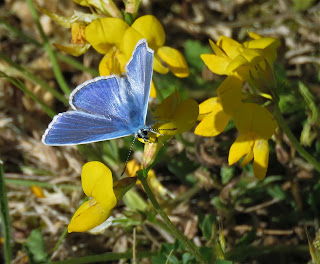
On Saturday, I took my camera and my phone to my local park to take photos of more plants. There's been a remarkable change since my last visit here. The fields are bursting with the colour yellow as bird's-foot trefoil and buttercups cover the landscape with patches of white ox-eyed daisies and the tufts of various grass species poking out amongst them. There were even a few red heads of poppies bouncing in the light breeze. And to add to the colours of this scene of early summer are common blue butterflies fluttering over to pollinate the trefoil.
 
What I really was hoping to find though are orchids. I was at least hoping that common twayblades and bee orchids would call this park home. Sadly, my more reliable spots in the city for orchids are now mowed down early for some reason (especially the spot near Carrow Road where I had great success with bee orchids last year). If anyone know of any orchid hotspots in Norwich that I don't know of, let me know. To include orchids to my city plant list would be the cherry on top of the cake.
 
June 1st  Thorpe Marshes
 

Norfolk Hawker
I was back at Thorpe Marshes yesterday looking for even more plants as well as the elusive corncrake that I can gladly say was still at this reserve. He was calling on and off in one corner of the grazing fields during this latest visit. Hidden somewhere deep within dense grass, there really wasn't any chance I was going to see it no matter how long I waited. At least I heard it, though sometimes it took 10-20 minutes until he made another outburst. An amazing sound nonetheless.
 
The corncrake may have been a no show, but at least the dragonflies weren't afraid to show themselves. There were plenty of them whizzing around the ditches as they competed in fierce aerial battles as they fought for territories. Norfolk hawkers brought a part of Strumpshaw that I've missed so much as I watched them hover in place with big green eyes clearly visible before they rush off to their next fight. I also saw four-spot chasers, hairy dragonflies and banded demoiselles as well as linnets, a kestrel, a buzzard, reed buntings, reed and sedge warblers and few more species to add to my plant list. I think I'm well over 100 species and there's so much more out there that I haven't added yet.

Sunday, 24 May 2020

Lockdown Plant Hunting (& A Corncrake)

For the last two weeks, I've taken my amateur plant hunting skills to new locations across Norwich. Since my last post, I've recorded a ton of new plant species to my list. I've been taking long walks and taken many photos for each new plant I expect is different and either posting them on a site to get IDed or figuring them out myself before sticking them into a scrapbook to help me remember what I've encountered so far. I'm hoping that I'm hoping to become a lot more of an expert to what I was before lockdown. Here's what I have been up to until now...

May 13th
 
Moving away from my local park, I decided to explore the streets and part of the River Wensum near where I live. I ended up doing a big loop, walking down as far as Anglia Square's car park and then along Marriot's Way that follows the river before making my way back home. Most of the plants were already on my list, but there were also plenty of new things too. This included; guelder rose, red valerian, beaked hawksbeard, Oxford ragwort, yellow-juiced and long-headed poppies (I checked the sap inside as both are identical), Mexican fleabane, hop trefoil, ivy-leaved toadflax, purple toadflax, large bittercress and groundsel.
Poppy
 
May 16th
 
Just a quick mention that I saw a muntjac deer run pass my flat (twice) from my kitchen window. It seemed to be in quite a panic, clearly spooked by people and cars. Never seen one in broad daylight this close to home before. I expect it was feeling a bit more confident to explore the urban world whilst lockdown was still in effect, but it must have realised that the streets weren't quite as empty as it thought. Not sure what happened to it when I saw it a second time running up the opposite direction.
  
May 18th
 
On Monday, I went on another even longer walk. This time, I made my way to Mousehold Heath, then to St James' Hill, then along part of the Wensum that I hadn't explored yet before heading home with sunburn, bramble scratches and nettle stings to remember the walk by. My list included broom, gorse (about 3 species worth), meadow saxifrage, dog rose, sheep's sorrel, field bindweed, ox-eyed daisy, yellow flag iris, common fumitory, red clover and creeping thistle, not to mention a few tree species as well. I also saw small copper and common blue butterflies and a few blue damselfly species. I discovered and explored various habitats, some were temporarily such as patches of meadows on mowed public lawns.
Common Fumitory
 
May 21st
 
On Thursday, I visited Thorpe Marshes, which is the furthest place I've visited since lockdown began. It is quite amazing to think that this reserve was still within the city's boundaries for me to include the plants here to my list. In fact, the place made me feel like I was at Strumpshaw than in Norwich. The habitats were quite similar as were some of the wildlife. There were cuckoos, dragonflies, mayflies, common terns, swifts, swallows, reed buntings, whitethroats and reed, sedge and Cetti's warblers. As for plants, I added; ragged robin, bittersweet, water soldier, celery-leaved buttercups, black medic, Japanese rose, common wintercress, cuckoo flower, silverweed, water forget-me-nots and white campion.
Female Hairy Dragonfly
 
Plant hunting was actually a side mission while I was at Thorpe Marshes. The real reason was to try and locate a corncrake that had been seen in the last two days prior to this visit. After I was dropped off by Mum, I went for a walk around the reserve, lingering more around the cattle grazing fields where it was more likely to be. When I completed the circuit of the reserve, I was unsuccessful. Not giving up, I made a second attempt around the grazing fields. I encountered a cuckoo, but no corncrake. Whilst still watching the cuckoo, I called Mum to arrange a lift. I started to walk back the way I came, down a path beside a ditch, when suddenly I heard it!
 
"Crex crex! Crex crex!" The loud, distinctive calls of a corncrake that are often described as running a finger across a hair comb. It sounded really close, just the opposite side of the ditch to me. This rare and elusive rail remained hidden and fell silent after its outburst. I called Mum to try and delay her a bit longer. I was now against the clock. The corncrake remained silent and out of sight. A man with a scope, who was just passing by, joined me in my wait. Another phone call later, this time it was Mum calling me, and the bird called again. It had followed me as I slowly shuffled away from its original spot as I attempted to partially walk away in order to head to the pick up spot while also trying to locate it. In the end I had to leave empty handed, but at least I got to hear it before I went.
  
May 23rd
 
Another trip to the southern side of the city, this time it was Dad who took me to Rosary Cemetery, Lion Wood and Kett's Heights. A few new plants to my list, but not that many. They include foxgloves, yellow corydalis and couple others I'm still figuring out. My scrapbook is filling out nicely with at least 80 species in it, though I've more than likely have seen way more than I've added to it.


Saturday, 9 May 2020

May 5th, 7th & 9th Catton Park

I've been starting to get really into visiting my local park this last week. Lockdown has brought me closer to my local patch than ever before. Since discovering the lesser whitethroat and experiencing the dawn chorus the other week, I've grown to love this place more and more. Why I haven't been visiting this place that much before the lockdown, I have no idea, but it has been a real lifesaver. I have no garden of my own and, since we've been restricted in our movements, a lot of my usual haunts like Strumpshaw are out of walking distance and have closed to the public anyway. I'm having to rely on more local places, like Catton Park, for my wildlife fix and it has been very rewarding and has surprised me on how much wildlife we have on the doorstep of this fine city of Norwich.


Stock Dove
During this last week, I've been trying so hard to find that lesser whitethroat again. I made two visits, one on the 5th on my own and another with my parents on the 7th, but there was no sign of the elusive warbler. There has been plenty of common whitethroats, but not lesser whitethroats. However, I did get to enjoy encounters with green and great spotted woodpeckers in the ancient oak trees at the centre of the park, though they were both as camera shy as my intended target. I have also seen plenty of stock doves and I've witnessed two crows mob a buzzard. As well as birds, there has been plenty of insect life too, namely butterflies in the form of speckled woods, orange-tips, peacocks and holy blues.


Today, I've came to a decision. I wanted to start a lockdown wildflower list. Plants are one of my weakest subjects. Sure, I've got to grips with the orchids last year, but the rest of our native floral life is another kettle of fish. So today, I have decided to attempt in starting a scrap book of all the wildflowers I've seen within my part of the city. Basically, anywhere within walking distance from my home in North Norwich. For now, I'm starting at Catton Park, but I'm hoping to also include plants from Mousehold Heath and any other local green spots within reach by foot. I'm not the greatest at plants, so if you live in my neck of the woods and want to share some findings or suggest some places I can walk to, let me know. Maybe, when lockdown has been lifted, I will continue this little project and visit other parts of the city and uncover more plants to my list.
 
 
Field Pansy
At Catton Park this morning, I managed to take a photo of as many notable plants that were in flower that I could find, including a couple of trees that were in flower. Possibly the pick of the bunch for me was field pansy, consisting of a single plant with a small number of tiny white flowers on it, each with the characteristic yellow centre marked with a set of black lines on them. I haven't found this plant here since 2007 when I first encountered them. I've been looking and looking, but with no luck what so ever. So I was very pleased to find this charming, minute flower. Its been a long time.
 
 
Kicking off my plant list (that I had a Facebook group help ID) were; wood avens, buttercup (Ranunculus sp.), Bulbous buttercup, dandelion, smooth sow-thistle, hedge mustard, yellow-flowered strawberry,  greater celandine, procumbent yellow-sorrel, Aquilegia (a.k.a  Columbine, or Granny's bonnet), a cranesbill that's still up for debate, wild radish, Herb Robert, garlic mustard, Germander Speedwell, yarrow, cow parsley, Alexanders, wild strawberry, white clover, common mouse-ear (I think), lords and ladies, greater speedwell, comfrey, daisy, common vetch, bird's-foot trefoil, English and Spanish bluebells, red and white dead-nettles, green alkanet, stinging nettle, red campion, cleavers, ground ivy, cowslip, hawthorn, horse chestnut and oak.  There were a few plantains and docks too, but I haven't sent them to be identified yet.


Sunday, 3 May 2020

May 3rd Catton Park

Dawn at Catton Park
Today is International Dawn Chorus Day. It is a bit of a tradition for me to get up really early and go somewhere in Norfolk with Dad to listen to the birds. This year, however, I had to go solo to my local park to do it. Lockdown Dawn Chorus Day was quite a strange concept, but it was kind of interesting. Believe it or not, I've never done a dawn chorus at my local park before. Before lockdown, visits to it was few and far between. It is a nice place to go, but I always favoured Mousehold or Strumpshaw as my preferred 'go to' places. Since lockdown though, I've been visiting Catton Park more often, mainly because it is the closest place to visit right now with a nice mix of woodland and open grassland to explore.

This morning, I arrived to Catton Park at 5am and the sun was already rising, producing a pink and orange glow. A light mist floats above the dewy wet grassy fields that dampens my boots. I was the only person around until 6:30am when a few dog walkers and joggers appeared. Woodpigeons, wrens, robins and blackbirds were in full voice. I wandered around the park, making a few videos that you can see below. The more I walked, the more species I added to my dawn chorus list which includes; blackcaps, blue tits, great tits, nuthatches, song thrush, pied wagtail (brief fly over), magpies, jackdaws, carrion crows, lesser black-backed gulls, stock doves, chaffinches, chiffchaffs, goldcrests and a jay.

My big highlights from my walk were a green woodpecker (that surprised me at the end of one of these videos, but I never saw it) and a few whitethroats. I don't recall seeing whitethroats at this park before, at least not during my more recent visits, so I was pretty pleased to hear them and plenty of them too. However, there was one bird I was hoping to hear that I heard during a random walk on Thursday. What I heard was a lesser whitethroat. I've never heard one at this park before and I was extremely happy to be the one to discover it despite not actually seeing it. Sadly though, it did not add its voice to the chorus this morning. A minor disappointment, but it was still a good walk that I felt showed me a secret time of this place that few people have probably experienced and it has brought me closer to this park than ever before.