Friday, 31 March 2023

Four Seasons At Once

 March 6th Strumpshaw Fen

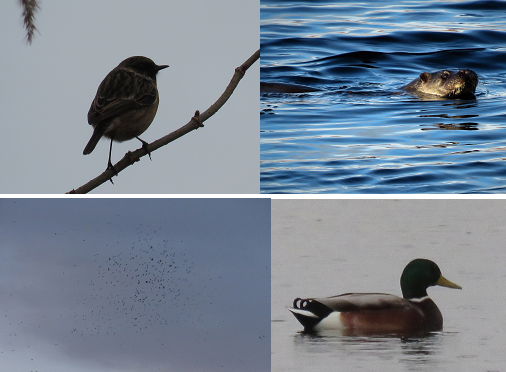
It was a very chilly start of the month, a sign of things to come. I began my first pre-shift walk with a stroll around the woodland trail, seeing redwings, scarlet elfcaps, siskins and a couple of primrose flowers. Then, after passing the pumphouse and along the muddy river path, I saw eye to eye with an otter that swam so close to my side of the bank that I thought it would climb onto the path with me. Sadly, it didn't, but it remained along the river edge partially obscured by the clump of reeds beside me. And then, it started to rain...

The rain was on and off for the remainder of the morning. It led to a rather dull day with very little about. There were fewer wildfowl on the broad than last month and the marsh harriers weren't very active either. However, another otter (or perhaps the same one) swam close to Reception Hide towards midday to make the day more worthwhile. During a dry spell, I went for a short look around the woods, hearing siskins and bullfinches. And when I returned, I missed a bittern!

Redwing & Otter (March 6th),
Brambling, Siskin,
 Muntjac & Some Jelly Fungus (March 11th)  

March 8th Whitlingham Broad

I was on a 2 week break, however, the weather decided to turn rather wintery. The temperature had dropped and snow was covering much of the country, though it hadn't reached Norfolk yet. With the fear of snow approaching, my parents decided that we stick to somewhere close by to avoid the worst of it. In the end, we went to Whitlingham Broad, hoping to complete the circuit before the snow arrived.

It was an ok walk with redpolls and siskins on the alders, tufted ducks, pochards, great crested grebes, gadwall, greylags, mute swans, Egyptian geese, mallards, Canada geese, coots, moorhens, a heron and a little egret. Halfway around the broad, we didn't escape the snow after all. It arrived in mini flurries, but it didn't really cover anything.

March 11th Lackford Lakes

It was my 37th birthday! And what better way to celebrate it than a day out with my parents to somewhere I rarely visit. We travelled over the Norfolk/Suffolk border to Lackford Lakes. I was hoping to find a lesser spotted woodpecker that I heard had been seen regularly here recently. Sadly, despite reported sightings during my visit, I was unable to see one. At least it was a nice sunny day.

The visit seemed rather disappointing at first glance. Nothing out of the unusual or that special that I haven't seen many times before. However, I did see enough to satisfy me on my birthday. You could say I left with a decent list which included; siskins, tufted ducks, pochards, wigeon, a lot of teal, several snipe, lapwing, Egyptian geese, Canada geese, greylags, great crested grebes, little grebes, oystercatchers, cormorants, a little egret, a heron, redwing, a brambling, reed buntings, rabbits and many muntjac deer. I also heard my first chiffchaff of the year. It wasn't a bad birthday outing in the end and we rounded the day off with a meal out.

March 13th Strumpshaw Fen, Buckenham Marshes, Breydon Waters, Filby Broad & Ormesby Little Broad

The bus was late! This forced me to catch a later train than usual. I then got to Strumpshaw with enough time for a short walk. It was a very windy day and to my surprise the colony of Clarke's mining bees were now out and very actively mating and digging holes. Amazing that they didn't all get blown away! In the woods, I saw siskins and amongst a flock of chaffinches was a brambling or two. 

I made my way back for my shift and as I reached Reception, I noticed a sign blocking my way that wasn't there earlier. The reserve was declared closed due to the 56mph gale force winds. For some reason though, the Reception Hide was to remain open. There wasn't much to see in this weather other than a few greylags, coots, 2 Canada geese, and the odd marsh harrier. However, there was a reward for staying at the end of the shift, as we had a female hen harrier surprising us out of nowhere and was being mobbed by some crows!

Tufted Duck (March 11th), Clarke's Mining Bees (March 13th),
Great Spotted Woodpecker (March 15th), Spoonbill
& Long-billed Dowitcher (March 17th)

After my shift, I went with my former Wednesday Reception Hide partner, Tricia, who asked me out on what was to be a very blustery mystery tour. First up was a visit to Buckenham. Wigeon, starlings, Chinese water deer, lapwing, a ruff and a distant flock of golden plover being spooked by a marsh harrier were the highlights here.

Next up, we made our way to an Asda car park in Great Yarmouth to climb up an embankment to try and scan the estuary of Breydon Water while trying to keep ourselves from being bowled over by the powerful gusts. The tide was in and it was hard to stand still while trying to look at the birds that were doing their best in sheltering from the wind, unlike us. We did manage to spot a pintail, large groups of curlew, dunlin, gulls and wigeon all huddling together for protection. 

Filby Broad was our next destination as a few ferruginous ducks had been overwintering here for a couple of months and Tricia wanted to see if we could find them. Unfortunately, we couldn't find them and the broad was as rough as the sea. It wasn't a complete waste of time as we did see some goldeneye, tufted ducks and a heron.

A short walk to Ormesby Little Broad on the opposite side of the road was a much calmer, sheltered  place to be compared to what Filby was like. No ferruginous ducks here either, but the place was full of great crested grebes, tufted ducks, a pair of gadwall and a great white egret that dropped into the reeds on the far side of the broad. Not the best of days, but it was still a nice adventure in the wind.

March 14th Catton Park

While I was out with Tricia, she introduced me to an app called Merlin. You make recordings with your phone and the app identifies bird songs and calls as it goes with a name and a picture of the bird popping up. It seemed interesting, so I installed it on my phone and, as it was a much nicer day, I went to test it out at my local park. You do need to rely on the phone's microphone range and noises such as traffic could prevent the app from picking up the bird sounds you want identified. But, with some patience, it actually works very well. It was able to capture the songs and calls of nuthatches, robins, blue and great tits, etc. Though at one point it, did pick up a short high pitched 'seep' of what it identified as a reed bunting. Kind of strange when I've never seen a reed bunting here before.

March 15th Sculthorpe Moor

It was a nice day and Mum was taking me out to Sculthorpe. On the way though, she accidentally knocked over a pheasant, traumatising me in the process. Poor thing! Not a sight I needed to start this outing with.

Once we got to the reserve, I was keen on showing Mum my latest app. It did well again, even though there was a sound of chainsaws that made the place a bit noisy as some work going on at the reserve. They were going to close off the reserve because of this work at 2pm, so we were now against the clock.

As well as the expected robins, chaffinches, wrens, blue and great tits, the app managed to record the sounds of bullfinches, siskins, redwings, coal tits, the drumming of a great spotted woodpecker, treecreepers, goldcrests and even an outburst of a blackcap that I didn't hear myself. As for actual sightings, we had; 2 red kites, bullfinches, a brambling, buzzards, a great white egret, muntjac deer, collard doves, a nuthatch, long-tailed tits, reed buntings and greenfinches.

March 17th Cley

My Aunt Barbara offered to take me out to Cley on her birthday and there were plenty of surprises to make her happy. The stars of the day had to be the spoonbills. We saw 7 in total. 4 flying on the way to the central hides, 1 at Pat's Pool (which gave us the best and closest of views) and 2 along East Bank.

Another highlight was the long-billed dowitcher, which was in front of two of the central hides, the first time I've seen it from these central pools. Also seen were avocets, snipe, lapwing, pintail, wigeon, teal, shovelers, shelducks, marsh harriers, a kestrel, curlews, dunlin heard chiffchaffs and bearded tits and my app identified a water pipit for me flying into an open area beside the East Bank, in which at that point it started to rain and rain hard. A very good day despite getting soaked at the end.

March 20th Strumpshaw Fen

No strong winds this time around to close Strumpshaw, but it was still a rubbish day as it was raining. But the rain did not stop me from walking to Fen Hide and in the woods to play around with my app a bit more. Through several recordings I made that day, it identified; chiffchaffs, nuthatches, greylags, Canada geese, marsh harriers, Cetti's warblers, treecreepers, goldcrests, marsh tits, redwings, a blackcap, a brambling and many other species. However, when I tried to record a large flock of several hundred siskins making a cacophony of twittering noise in the woods, the app struggled to single out the species, they were that noisy!

The rest of the morning was a bit of a washout with very little out of the ordinary. But then out of nowhere, the sun came out and was warm enough for the mining bees to emerge by the bench at the start of Sandy Wall and at the sand cliff area.

March 26th Honing

I decided to make a new addition to my displays and spectacles challenge as I realised that none of my selections were around in March. So, I decided to add a daffodil display to the list. I discovered that there was going to be a daffodil day at Honing, a place I never even heard of until I did my research. 


I went to see the mile long display down a road leading out of the small village with Barbara. If you wanted to, there was an option for the day to see them via tractor, but the best way was on foot. On either side of the road was daffodil after daffodil. Though these weren't wild or anything, it was still an enjoyable walk. The daffodils weren't exactly the ones I expected with the traditional long trumpets, but they were tall and there was a variety of yellows and whites forming two lines that led you down the mile. One side had more daffodils than the other, but it made me feel what Wordsworth wrote in his famous daffodil poem with the sound of skylarks and other birds in the background.

Daffodils (March 26th)
Redpoll
& Nomad Bee (March 27th) & Kestrel (March 17th)

March 27th Strumpshaw Fen

There was a chill in the air again. A few hail showers disrupted what was actually a nice day with the sun trying to warm things up. A late bus made me catch the later train again, which gave me very little time around the reserve as the opening hours to Reception Hide changed to 9:30am. I walked to the sluice gate, but it was very muddy and that was about it.

Siskins and redpolls were by Gnarly Oak and I heard chiffchaffs and a blackcap. The mining bees were still active and I found a nomad bee (which lays their eggs in the mining bee's nests) amongst them. Marsh harriers were putting on quite a show, performing their aerial displays. At least 7-10 males were stooping and rising back again and rolling around in the air together. I also spotted buzzards and a sparrowhawk up there with them as well as a red kite.


Tuesday, 28 February 2023

Snowdrops & Starlings

 Feb 5th Walsingham Abbey

The snowdrops at Walsingham Abbey were finally out and at their best. As seeing them was part of my displays and spectacles challenge, my parents and I were really looking forward to ticking this floral display off my list.

Snowdrops,
Hellebore & Mistletoe (Feb 5th),
Misty Morning & Reed Bunting (Feb 6th)

Snowdrops are one of the earliest flowers to bloom and though they had been popping up as early as mid-January. However, we decided to wait a little longer for the display to develop into something we expected to be something amazing before setting off to see them. So, when we finally visited on a beautiful sunny Sunday, the wait was completely worth it. The woodland trails around the abbey grounds were just breathtaking! It was like the place was covered in actual snow.


As well as the snowdrops, there were also the yellow flowers of winter aconites, some hellebores, clumps of mistletoe, the odd primrose and even one of the first daffodils of the year poking through.

Feb 6th Strumpshaw Fen

There was a chill in the air, but it was feeling rather spring-like as there was a pleasant warmth from the sun. The paths were actually drying out and I managed to get to Tower Hide without getting too muddy. While at the hide, I counted 130 greylags, 25 shelducks and smaller numbers of gadwall and shoveler.

Back at Reception Hide, there was to be a wildfowl bonanza here too with 60+ greylags, 25+ gadwall, a few mallards, 2-3 mute swans, 2 Canada geese, and the odd shoveler. Marsh harriers were also around (as was a sparrowhawk) and seemed to be sky dancing at times. 

Around the woods, the place was alive with hundreds of siskins and redpolls as well as the sound of drumming great spotted woodpeckers, trilling treecreepers and, for the first time I've seen at Strumpshaw for some time, a nuthatch! Scarlet elfcap fungi were looking vibrant on the woodland floor and snowdrops were now everywhere (though not as spectacular as the display at Walsingham), including in front of Reception Hide.

Feb 13th Strumpshaw Fen

An overcast morning, grey and rather quiet. I had to catch a later train than usual due to my bus having a alarm to go off and had to stop for a while for the engine to cool down. I couldn't wait, so I had to walk some way through the city to get to the station, bought a ticket, got on the platform just in time to see the usual timed train leave. I was so close! 

When I eventually arrived at the reserve, I still had time for a short visit to Fen Hide, seeing a Chinese water deer, 2 swans, a heron, 2 greylags and a marsh harrier. I then managed to squeeze in a quick walk in the woods where siskins continued to make a noise along with treecreepers, nuthatches and woodpeckers. 

The sun tried to come out during my shift at Reception Hide and the broad had a large number of greylags again as well as 2 shelducks, a few coots, and the odd gadwall and mallard. The marsh harriers were at their best and seems to be in full sky dancing mode.

Feb 15th Cley & Norwich

With Valentine's week off from work, Mum and I went out to Cley. It was a really good day for it and there was plenty of birds out on Pat's Pool. This included a whooper swan that sat in the middle of an island full of many lapwing before going on a tour around the pool.

Nuthatch & Scarlet Elfcaps (Feb 6th)
Siskin (Feb 13th), Whooper Swan,
Long-billed Dowitcher & Snow Buntings (Feb 15th)

Also at Pat's Pool were avocets, pintails, wigeon, teal, shelducks, black-tailed godwits and a marsh harrier. On the walk back to the visitor centre, a red kite flew over us and we had a stonechat perching on a bramble branch.

We then moved on to the East Bank. The long-staying long-billed dowitcher was here again and it was showing well. It was the closest I've ever gotten to this American wader and I finally got some decent photos of it. Many others crowded that one section of the bank to enjoy this  small godwit-like bird, though Mum lost interest fairly quickly and didn't know what all the hype was about.

We then made our way to the beach and joined another crowd. This time to see 20-30 snow buntings on the shingle mound. Unlike the dowitcher, Mum was showing a lot more interest this time. Who wouldn't? They are always a charm to watch.

After returning home, we spent some time at my flat before heading out again. While at Cley, we were given a tip-off that a mini murmuration of starlings has been occurring in the city. So this evening, Mum took me to an Asda store car park at Hall Road in Norwich to try and see it for ourselves so I could tick it off of my list.

It took a while until I saw the first 3 starlings arriving at around 5pm. Three became 20, which became 50 and so on until a ball of roughly a few thousand were swirling over us. It wasn't the biggest or the most impressive murmuration I've ever seen, but it was still quite an experience to have them whoosh over my head all the same. As a ball, they mainly went round and round the car park in the sky over and over. Sometimes a few would break off and rejoin, while other large groups would arrive from nowhere to join the main group to bolster the numbers. 


The sight of them circling many times did make me feel a little dizzy. Eventually, at about 5:50pm it was time to roost and they all suddenly poured into two tall larch trees near the supermarket's petrol station. And then it was all over. The trees was just filled with chattering starling noises. It was at this point that I noticed. They got me! Not only me, but also my mum and the car. There was a price to enjoying this marvel it seemed.

Feb 17th Minsmere

On my final day off that week, my parents (who both also had the day off) and I visited Minsmere. We began our walk to Island Mere Hide. From the packed hide, there were 3 snipe feeding in the stubble just by the front, several tufted ducks, a couple of mute swans, a few flying marsh harriers and curlews and a pair of goosanders (a male and a female). I don't see many male goosanders, so I was fairly happy.

Pintail & Starling Murmuration (Feb 15th),
Goosanders (Feb 17th) & Blossom (Feb 20th)

A walk in the woods produced marsh tits and the sounds of siskins and treecreepers. The Bittern Hide wasn't very interesting other than a couple more marsh harriers.

After lunch, we visited North Hide, seeing many, many curlew, wigeon, shovelers, a flock of goldfinches, lapwing and a little egret.

We then checked out the brand new boardwalk that bypasses the beach and takes you to East Hide. The walk seemed to be longer than it actually was as the path felt very open and exposed. It appeared to stretch on and on without much growing beside it to obscure the length of it. There was even a new elevated section that went round the old track that used to lead you up to the hide from the beach.

From the hide itself, there was a lot to see. I don't recall seeing so many pintail in one place in my life! Also seen here were; 3 avocets, a flock of dunlin, the odd turnstone, a pochard, gadwall, shovelers, teal, shelducks, herring gulls, lesser and great black-backed gulls and some distant marsh harriers.

Feb 20th Strumpshaw Fen

A beautiful sunny morning. I did a walk in the woods, to the pumphouse and to the sluice gates before heading back for my shift. I heard more than I saw with drumming woodpeckers, siskins, meadow pipits, a bullfinch, 5 buzzards soaring above my head, scarlet elfcaps, snowdrops and a single primrose that was in flower.

There was some excitement over the weekend it seems, as I read the sightings board for Sunday 19th. It stood out from the rest. Written there was; WHITE-TAILED EAGLE!!! Apparently, a tagged bird from the Isle of Wight reintroduction project had flown by the front of Reception Hide! I looked and looked and looked, but sadly I could not find it anywhere. The best I could muster was an otter, several displaying marsh harriers and buzzards, some fighting coot, around 60-70 greylags, 2 shelducks and a small tortoiseshell butterfly in which I rescued from inside the Reception Hide as it tried to escape but the window was closed.

Feb 27th Strumpshaw Fen

I woke up, boarded the bus and there was no rain. I got off the bus in the city and it was raining. Then it was sunny by the time I got off the train at Brundall. A very strange start to the morning. 

After a short visit to Fen Hide, seeing only a Chinese water deer, I decided to go to Tower Hide. Big mistake! The rain earlier must have dampened the way to the hide as it was very slippery and very muddy in places. It was awful. When I got to the Tower Hide, there wasn't anything too exciting other than 13 teal, 6 mallards, some greylags and a marsh harrier. Nothing worth treading through slippery mud there and back for.

On the way back to Reception Hide, I came across some siskins and heard bullfinches and drumming woodpeckers. During my shift, the broad was full of greylags, gadwall, coot, mallards, 2 shelducks, 2 mute swans and 2 Canada geese, while marsh harriers and buzzards were busy displaying. I watched one male harrier go up and down like a yo-yo. Other than that, it was fairly unexciting to end my final shift of the month.

Wednesday, 1 February 2023

A Brand New Challenge

Before I get started with my sightings from this month, I'd like to announce my brand new challenge. No, it isn't a bird list. This time it is something completely different. So for 2023, I want to see as many displays, spectacles and events as I can. That's as many flower displays, murmurations, roosts and other things I can think of that I can probably see in Norfolk. I may need some help on a few I'm not sure about, such as the Natterjack toad one, or maybe even give me a new idea to add for the checklist that I haven't thought of yet. Here's my checklist that I've made for this challenge. What do you think?


Jan 7th Cley

The first trip of the year 2023.After taking the rest of December off due to work and Christmas, I was itching to get back to birdwatching. Unfortunately, it was a very windy day at the coast with some rain. It was to be a rather rubbish visit to Cley, though Mum and I did see a buzzard, a hare and a red kite on the drive up.

Stonechat (Jan 7th), Otter (Jan 9th),
Rook Roost (Jan 14th) & Mallard x Shoveler Hybrid (Jan 16th)

There were skeins of pink-footed geese, golden plovers, many lapwing, a couple of marsh harriers, a curlew, shelducks, but no sign of the long-billed dowitcher that was still about from the last time I saw it, though it was distant and so well hidden that I couldn't find it while I was looking for it along the East Bank. I also had a nice encounter with a stonechat, but nothing really to make this outing that memorable other than cake and pasties at the café.

Jan 9th Strumpshaw Fen

My first shift at Strumpshaw. It started with siskins in the alders next to Reception Hide, which may have had a redpoll amongst them. I didn't really had the best light and they flew off before I could study the noisy large flock to verify. 

In the woods, I spooked a muntjac deer, while at Fen Hide, it was pretty empty other than 2 greylags and pink-footed geese. During my first shift of 2023, the main highlight was an otter right in front of the Reception Hide. It came as close as the measuring post. A great white egret arrived as soon as the otter left. There were also 32 greylags, 3 mute swans and a couple of marsh harriers along with many visitors at the reserve, the most I've seen in recent months.

Jan 14th Buckenham

I began my new challenge to see as many displays and spectacles during this year by visiting Buckenham to see the largest rook roost in the UK. Around 50,000 - 60,000+ rooks and jackdaws congregate to a set of trees near the church and have been recorded doing so since the Doomsday Book in 1086. I've seen it a few times before and it never ceases to amaze me.

Dad and I waited for dusk in the wind and the odd rainy spell by the edge of the field they normally gather at before heading for the trees to roost. However, they never arrived to the field. I guess the windy weather had put them off. We didn't get to see them perch along the wires either, in which their weight causes them to bend slightly.

They arrived at 4:20pm, at this point a large birding group joined us to watch them fly as the sun was setting. They swirled around the sky like a snow globe in the dark with black snowflakes. Thousands and thousands of them! Like a scene from Hitchcock's 'The Birds'! It was an incredible sight with an unbelievable sound as they cawed in unison. And then, before 5pm, they all slowly and gradually landed into the trees for the night. You couldn't have asked for a better way to start the new challenge off.


Jan 15th Norwich

The rook roost made me want to see another roost that's on my list. And the best thing was, I didn't have to travel miles to go see it either. All I had to do was walk into Norwich and wait at the bus station for dusk. You're probably wondering what I could possibly see at a bus station in the middle of a city. Well, I heard that hundreds of pied wagtails have been arriving here to roost most nights. Though not as large in number as the rooks at Buckenham, it will still be quite an interesting experience.

While everyone were more interested in catching a bus, I watched these small birds fly up onto the station's roof and up onto the surrounding buildings one by one, then in smaller groups. I was expecting the bus station roof was to be the final destination, but it wasn't.

They eventually moved away from the roof and I followed them down an alley behind the YMCA building and into a buddleia bush. They continued to arrive, decorating the bush like black and white baubles, possibly a few hundred of them. At first, there was a chorus of 'chessick' calls, but then as they settled down in the bush, I could hear strange click-y chattering noise. Was this their way of talking to each other? Just like the rooks, it was all over by 5pm.


Jan 16th Strumpshaw Fen

It was starting to spit with rain as I got to Strumpshaw this morning. By the time I got to Fen Hide, it was tipping it down! There was nothing but a soggy marsh harrier for quite some time. Then the rain temporarily stopped and a buzzard and a Chinese water deer appeared just before I made a dash for it between showers.

At Reception Hide, the weather was temperamental as it changed from rain to sunshine to rain accompanied strong winds. The wildlife was also very changeable. There was a great white egret one moment, then 32 mallards, 7 gadwall, 6 teal and 23 greylags the next and then an otter to spook them all off. Amongst the mallards was a mallard x shoveler hybrid, which had the head of a mallard and the body of a shoveler. I also saw a little egret and a great spotted woodpecker.

Jan 18th Sculthorpe Moor

I had 3 days off from work and what better way to spend the first day than with a trip out to Sculthorpe. Mum also had the day off, so it was like old times. Though, it was rather cold and icy as the reserve was still covered in frost and sheets of ice. It was like the Arctic!

We had a great haul with bullfinches, greenfinches, chaffinches, blue, great, coal, marsh and long-tailed tits, siskins, nuthatches, pheasants, a brambling, redwings, several muntjacs and a tawny owl that was snoozing at the front of an owl nest box in the woods (my 2nd ever in broad daylight!).

However, the real highlight was to be something I've always wanted to photograph and my first time seeing one in the day. We were making our way to the new lake hide, but a lady in a Hawk & Owl Trust uniform stopped us. 

"We've got a woodcock out at the moment. Do you want to see?" 

My heart skipped a beat! Of course I wanted to see it! So, she took us round the corner, walked up the ramp of the tower hide a little way, stopped a bench on a bend in the ramp, peered over the side and pointed down at the woodland floor below. And there, like some magical beast from mythology was the woodcock staring right back at me with one large black marble of an eye. It was very active, probing the ground for worms. I couldn't believe what an amazing view I was getting, seeing all its beautiful camouflage in great detail. I was blown away! Just wow! Eventually, the woodcock wandered back into the woods away from the ramp. 

Brambling, Tawny Owl,
Woodcock (Jan 18th), Fox,
Barn Owl & Sunset (Jan 19th)

After a slightly uneventful visit to the tower hide itself (other than goldfinches), we went to the lake hide (where beavers were introduced a year ago as part of a re-introduction project). It was so cold! The lake was frozen over. A great white egret stopped by, standing on the ice was the only thing to be seen. We had lunch, before feeling so cold that we decided to end the visit and head for the warmth of home.

Jan 19th St Benet's Abbey & Hickling Broad

For my 2nd day off and my 3rd tick for my challenge, I took my scope and a train and met up with former Reception Hide colleague, Tricia, at Brundall station to eventually see the harrier roost at Hickling. First though, she and her friend, Christine, took me to St Benet's Abbey near Ludham to kill some time. We were hoping to see the short-eared owls that had been visiting this place that I've never been to on a daily basis. Sadly, there were no short-eared owls in sight. However, we did see barn owls. Two of them. Not only that, but also 2 foxes hunting in the frosty long grass, a crane on the other side of the river, 2-3 kestrels, a buzzard, a pair of stonechats and some distant Bewick's swans in a distant field in the horizon.

It was getting towards sunset, so we made our way to Hickling. We navigated down a long, ice-covered path to Stubb's Mill. The platform there was already attracting an audience and the show was already unfolding in the field in front of us with a barn owl and a hen harrier (which I missed). The raptor roost was good but not as good as when I last here last year. However, we did roughly count around 25+ marsh harriers, 2-3 hen harriers (one being a male, which was the one out of three I did actually see myself swooping around like a pale ghost with black wingtips alongside the marsh harriers) and roughly 15+ cranes coming in for the night. Everything was very far away. Good job I brought my scope!


We also had a kingfisher perched above the ditch behind us and heard a bullfinch. It was all rounded off with a fantastic red sunset. The perfect way to end the night, even if we did have to navigate the same icy path again, this time in the dark!

Jan 23rd Strumpshaw Fen

The temperature dropped to -4°C and was absolutely freezing! However, it lead to the perfect conditions for my next challenge objective; hoar frost. Strumpshaw was transformed into a winter wonderland with every vegetation decorated in spikes of ice. Every leaf, branch, berry, reed head and even moss became crystallised, beautiful, temporary jewels. I marvelled at them all. Absolutely breathtaking!

Frosty Scenes,
Redpoll (Jan 23rd) & Fieldfare (Jan 30th)


All though the frost only lasted for a short while, there was another captivating sight (and also sound in this case) that lasted far longer. A flock of siskins were making a racket in the alders, hundreds of them! And within their flock, I managed to spot some redpoll. They almost blended in so well that I could have dismissed them as siskins as they appear very similar. Thankfully, the red patch on their foreheads gave them away. I enjoyed this flock so much, I revisited them a couple more times throughout the morning.

Also seen were; bullfinches, marsh harriers, fieldfares, water rail, Chinese water deer, scarlet elfcap fungi and lots of ice as all the broads, ponds and ditches were all frozen solid.

Jan 29th Norwich

It was the RSPB's Big Garden Bird Watch weekend and I went to my parent's house yet again to do it. Last year, my parents were out and I had to do the one hour survey alone. This time, Dad and my niece, Ava, was here to watch the birds with me. 

There was quite a good turnout this year as we even had a flock of gulls circling for the bread that Dad put out on the lawn. Only one black-headed gull was brave enough for me to count it in the garden. We started at 9:06am and during the hour we counted; 1 magpie, 2 blackbirds, 2 woodpigeons, 1 blue tit, 2 greenfinches, 2 robins and 1 dunnock. Our best haul in quite some time!

Jan 30th Strumpshaw Fen

A fairly quiet morning, except in the woods, where the many siskins and redpolls were making a lot of twittering. I also encountered a fieldfare and a muntjac deer, while at the Reception Hide were 3 swans, 6 greylags, several mallards and marsh harriers and buzzards very briefly before all of them disappeared and left me with a very empty scene for most of the morning. It was a bit windy out on the broad and 3-4 bearded tits braving the strong gusts to feed on the reed heads from the reedy islands, riding them like a rodeo horse, was the last thing I expected to see. 

Saturday, 31 December 2022

My Bird List 2022

 Here's a list of all the birds I've seen this year. I did one last year, so I've decided to do one for 2022 as well. Bucket list birds (birds that I'm trying to photograph as part of my challenge) will be marked as (BL). Those on my bucket list that I've seen but failed to photograph will be marked as (X). Other highlights will be marked as (H). All birds that I've only seen from Spain in May are marked as (ES).

  1. Mute Swan
  2. Bewick's Swan
  3. Whooper Swan
  4. Canada Goose
  5. Brent Goose
  6. Red-breasted Goose (BL)
  7. Barnacle Goose
  8. Greylag Goose
  9. Russian White-fronted Goose
  10. Pink-footed Goose
  11. Shelduck
  12. Egyptian Goose
  13. Wigeon
  14. Mallard
  15. Shoveler
  16. Gadwall
  17. Pintail
  18. Teal
  19. Garganey
  20. Goosander
  21. Mandarin Duck
  22. Pochard
  23. Red-crested Pochard (H)
  24. Tufted Duck
  25. Scaup
  26. Goldeneye
  27. Eider
  28. Common Scoter (H)
  29. Shag (H)
  30. Cormorant
  31. Red-throated Diver
  32. Great Northern Diver (H)
  33. Great Crested Grebe
  34. Little Grebe
  35. Gannet
  36. Little Gull
  37. Black-headed Gull
  38. Mediterranean Gull
  39. Common Gull
  40. Herring Gull
  41. Lesser Black-backed Gull
  42. Great Black-backed Gull
  43. Iceland Gull (BL)
  44. Common Tern
  45. Sandwich Tern
  46. Little Tern
  47. Guillemot
  48. Razorbill
  49. Oystercatcher
  50. Turnstone
  51. Avocet
  52. Black-winged Stilt (H)
  53. Little Ringed Plover
  54. Ringed Plover
  55. Lapwing
  56. Dotterel (BL)
  57. Grey Plover
  58. Golden Plover
  59. Sanderling
  60. Knot
  61. Dunlin
  62. Little Stint
  63. Temminck's Stint (BL)
  64. Ruff
  65. Redshank
  66. Greenshank
  67. Spotted Redshank
  68. Wood Sandpiper (H)
  69. Common Sandpiper
  70. Green Sandpiper
  71. Curlew Sandpiper
  72. Purple Sandpiper (H)
  73. Black-tailed Godwit
  74. Bar-tailed Godwit
  75. Long-billed Dowitcher (BL)
  76. Curlew
  77. Snipe
  78. Jack Snipe (H)
  79. Grey Heron
  80. Bittern
  81. Little Egret
  82. Great White Egret
  83. Cattle Egret (H)
  84. Glossy Ibis (H)
  85. Crane (H)
  86. Spoonbill
  87. Moorhen
  88. Coot
  89. Water Rail
  90. Red-legged Partridge
  91. Grey Partridge (H)
  92. Pheasant
  93. Rock Dove/Feral Pigeon
  94. Woodpigeon
  95. Stock Dove
  96. Collared Dove
  97. Tawny Owl
  98. Little Owl (H)
  99. Barn Owl (H)
  100. Nightjar (H)
  101. Osprey (H)
  102. Buzzard
  103. Red Kite
  104. Marsh Harrier
  105. Hen Harrier (X)
  106. Sparrowhawk
  107. Kestrel
  108. Hobby
  109. Peregrine
  110. Kingfisher
  111. Bee-eater (H)
  112. Cuckoo
  113. Green Woodpecker
  114. Great Spotted Woodpecker
  115. Wryneck (H)
  116. Swift
  117. Swallow
  118. House Martin
  119. Sand Martin
  120. Skylark
  121. Meadow Pipit
  122. Rock Pipit
  123. Pied Wagtail
  124. Grey Wagtail
  125. Yellow Wagtail
  126. Dunnock
  127. Wren
  128. Starling
  129. Ring Ouzel (BL)
  130. Blackbird
  131. Song Thrush
  132. Mistle Thrush
  133. Fieldfare
  134. Redwing
  135. Robin
  136. Stonechat
  137. Whinchat
  138. Black Redstart (H)
  139. Wheatear
  140. Cetti's Warbler
  141. Sedge Warbler
  142. Reed Warbler
  143. Grasshopper Warbler
  144. Blackcap
  145. Garden Warbler
  146. Whitethroat
  147. Lesser Whitethroat (X)
  148. Chiffchaff
  149. Willow Warbler
  150. Dusky Warbler (X)
  151. Goldcrest
  152. Spotted Flycatcher
  153. Bearded Tit
  154. Long-tailed Tit
  155. Blue Tit
  156. Great Tit
  157. Coal Tit
  158. Marsh Tit
  159. Nuthatch
  160. Treecreeper
  161. Jackdaw
  162. Carrion Crow
  163. Raven (BL)
  164. Rook
  165. Jay
  166. Magpie
  167. House Sparrow
  168. Bullfinch
  169. Brambling
  170. Chaffinch
  171. Goldfinch
  172. Greenfinch
  173. Siskin
  174. Linnet
  175. Yellowhammer
  176. Reed Bunting
  177. Snow Bunting
  178. White Stork (ES)
  179. Purple Heron (ES)
  180. Lammergeier (ES)
  181. Egyptian Vulture (ES)
  182. Griffon Vulture (ES)
  183. Short-toed Eagle (ES)
  184. Booted Eagle (ES)
  185. Golden Eagle (ES)
  186. Montagu's Harrier (ES)
  187. Black Kite (ES) (BL)
  188. Yellow-legged Gull (ES)
  189. Turtle Dove (ES)
  190. Alpine Swift (ES)
  191. Hoopoe (ES)
  192. Iberian Green Woodpecker (ES)
  193. Red-backed Shrike (ES)
  194. Woodchat Shrike (ES) (BL)
  195. Golden Oriole (ES)
  196. Red-billed Chough (ES)
  197. Alpine Chough (ES)
  198. Crested Tit (ES)
  199. Woodlark (ES)
  200. Crested Lark (ES)
  201. Crag Martin (ES)
  202. Western Bonelli's Warbler (ES) (BL)
  203. Melodious Warbler (ES) (BL)
  204. Western Orphean Warbler (ES)
  205. Subalpine Warbler (ES) (BL)
  206. Sardinian Warbler (ES) (BL)
  207. Firecrest (ES) (BL)
  208. Short-toed Treecreeper (ES)
  209. Spotless Starling (ES)
  210. Nightingale (ES) (BL)
  211. Rufous-tailed Rock Thrush (ES) (BL)
  212. Blue Rock Thrush (ES) (BL)
  213. Rock Sparrow (ES) (BL)
  214. Water Pipit (ES) (BL)
  215. Crossbill (ES)
  216. Citril Finch (ES) (BL)
  217. Serin (ES) (BL)
  218. Corn Bunting (ES)
  219. Rock Bunting (ES) (BL)
  220. Ciril Bunting (ES)

Friday, 30 December 2022

Ice & Rainbows

 Dec 5th Strumpshaw Fen & Buckenham Marshes

A very changeable day as it kept changing from rain, sunny spells and some very colourful rainbows, but mostly rain. I arrived early enough to see the starlings leave the Reception Hide, just a few thousand flying over my head without anything fancy. At Fen Hide I saw a little egret, Chinese water deer, marsh harriers and bearded tits. A quick walk to the river was cut short by another rain shower, but I did encounter a few fieldfares.

During my shift at Reception Hide, an otter made a couple of visits and we actually had ducks on the broad for the first time in what seems like some time ago (plenty of them, mostly mallards and some gadwall), marsh harriers, a sparrowhawk and a buzzard, 4 mute swans (a pair with a near-fully grown cygnet that had territorial disputes against the 4th) and a couple of brightly coloured rainbows arching across the reserve.

After my shift, I was invited to a walk at Buckenham as I missed out on the annual Christmas get-together due to work. I joined with my group of 3 others on what was an afternoon of mixed fortune. We enjoyed views of many wigeon, lapwings, several Chinese water deer, marsh harriers, a single pink-footed goose, greylags, Canada geese, some barnacle geese, 4 white pheasants and my final new addition to my bird list, white-fronted geese. However, the weather was awful. It kept raining on and off, but the worst of it happened as we decided to head back to our cars. We were all soaked to the bone!

Little Egret, Rainbow,
Wigeon (Dec 5th), Icy Scene,
Frozen Rosehips & Water Rail (Dec 12th)

Dec 12th Strumpshaw Fen

The temperature dropped below zero and to say it wasn't a bit cold was a bit of an understatement. I brought my hiking stick to help navigate through the slipperiest of paths as I made my journey to Strumpshaw on foot. The reserve itself was mostly frozen over and very quiet. Before my shift started, my morning walk produced fieldfares, bullfinches, herons, marsh harriers, 3 swans on ice and a Chinese water deer.

From Reception Hide, the broad was just ice and nothing much on it. At least there was a large flock of bearded tits (about 10+) feeding on reed heads at the reedy islands and a water rail showing well close to the hide to give me something to look at.

Dec 19th Strumpshaw Fen

It was a much warmer day, but the ice still remained on the broad outside the Reception Hide, though it was hard to notice unless you looked closely enough. There wasn't too much about either. Two great white egrets, marsh harriers, 3 mute swans, herons, buzzards, the odd bearded tit and, on the feeders, a great spotted woodpecker.

This was to be my last outing of the year as I spent Christmas with my family, Strumpshaw was closed on Boxing Day and work took up my week days. It was a year that had started well, but kind of slowed towards the end of it. I've seen plenty of great birds, especially when I went to Spain in May. If you want to see my full bird list of the year, I will post it in full later. As for next year, who knows. I may have a challenge in mind. However, I still haven't planned it out fully yet, so watch this space. For now, I hope you all had a great Christmas and I wish you all a happy new year. Here's to 2023!

Thursday, 15 December 2022

8 Years On

 It has been 8 years since I started this blog. It has been one of those years where it has been a mixed bag. Half the year, I've been out and about, seeing some incredible birds, accumulating a good sized list. I even been to the Spanish Pyrenees on quite the adventure. However, the second half of the year, I've been stuck, unable to travel that often and the new bird species for my list petered out. 

Despite that, I did add some amazing birds, some I've never seen before. So, to celebrate my 8th year, I thought I look back at my top 10 highlights so far. Counting down from number 10, here are my favourite new species that I've seen in 2022...

10. Lammegeier - Yes, I know. This should be number one. However, because I didn't get a decent photo and the views were so fleeting, I just can't put it any higher than 10. This is a large and impressive bird of prey also known as a bearded vulture and eats bones by carrying them to the air and dropping them onto the rocks below to eat the marrow inside. It is an endangered species that was very high on my list when I went to the Spanish Pyrenees. On day 3 of the trip, I finally got to see one fly over us while we were at the pretty mountain town of Anso, having a drinks break sitting outside a café. It was such a fleeting glimpse and was so unexpecting, that I wasn't able to pick up my camera quick enough. I then had to use the toilet inside the café. In that time, it appeared again. I couldn't believe it! We did see a couple of others, but they were much further away. The views weren't as good as that first encounter.

9. Long-billed dowitcher -  This is another that I saw, but couldn't get a decent photo. It was a bit of a wild goose chase to find as I didn't know where it was. After a lot of walking back and forth and searching between Cley and Salthouse, I eventually found it. The light wasn't the best and the bird was fairly distant, but I did have a good look at it. This American wader was more or less like a dark snipe to me, but roughly the size between a snipe and a godwit. It was rewarding after the day I had, however, I really wish I had a better photo of it.

8. Great northern diver - Sea watching is one of my weakest side when it comes to birding. Everything is distant and unable to fully identify things well enough without an expert there to confirm what I'm seeing. Unfortunately, no one was around the day I decided to do a spot of sea watching at Sheringham in November. However, I did manage to find a bird that sat on the sea long enough for me to decide on its identity. In the end, I decided that it was a great northern diver. It looked big enough even from the distance I was seeing it. I've never seen one before and I was confident that it was one. Sadly, I have no photo for my collection, but it was still great to finally see one at long last.

7. Red-breasted goose - In March, I managed to see my first red-fronted goose out in the wild. Of course, it could have been just an escapee, but as far as I know, it was a wild one. I've seen plenty of captive individuals of this colourful species, but this was the first time I've seen one mingling with a flock of wild brent geese at Cley. 

6. Temminck's stint - Not the most attractive of my highlights as it was just a non-descript, tiny brown wader. But it was something I never had seen before and despite its size, it was actually a very charming bird and full of character. I watched it move along the edge of the pools in front of the Parminder Hide at Titchwell, swaying its head from side to side.

5. Dusky warbler - This one gave me and my friend, Trish, on a bit of a run around. We were at Stiffkey, walking up and down this ditch by the main path and I heard a strange 'tssk' call and caught a glimpse of it. We found a group of birders in the wrong spot and we took them to the area and we kept getting glimpses as well as hearing the call occasionally. At one point, it was right in front of me for a brief second. I couldn't get a photo, it was just too quick, but it was a fun experience all the same.

4. Sardinian warbler - This has to be the bird that has provided me with my favourite photo that I took this year. While I was at the Pinnacles of Riglas, these charming little warblers were everywhere. However, they were tricky to photograph. They kept moving out of shot and it took several attempts until I got what I wanted. 

3. Nightingale - Though I have glimpsed one a long time ago and have heard them a few times, I've never had a decent view of one. While out in Spain, I made it my mission to find and photograph one. I didn't need to go far from where I was staying as one was singing from outside my room's window. It took until my 3rd day to actually get what I wanted. I finally got my photo of one of Europe's best songsters. This was a day after losing my phone up a mountain and I was feeling rather down because of it. It was an emotional moment that lifted my mood and left me in tears.

2. Blue rock thrush & Rufous-tailed rock thrush - Taking joint 2nd place, the blue rock thrush was probably the best bird I saw while I was in Spain. We found it sitting on a wall of a dam with a bill full of worms. An absolute stunner! Bright blue! A couple of days later, I also managed to spot a rufous-tailed rock thrush poking behind a rock. Though not quite as stunning as the blue rock thrush, I'm putting it as joint 2nd because I was the one who spotted it and it was quite a hidden and even my group leaders couldn't believe how I even found it.

1. Bee-eater - For the first time, I got to see a colony of bee-eaters in the UK. I did see one in the past in Spain and I saw a colony by a river in the Pyrenees in May as well, but this was the first time they were breeding in Norfolk. This made them very special and were very successful. These rainbow birds at Trimingham provided me with some of the best views I've ever had. They were magical! I watched them catch bees and hit them against a wire to remove the sting. A bird well deserving of No.1 spot!

Wednesday, 30 November 2022

Dead Ends & Distractions

 Nov 14th Strumpshaw Fen

On November 7th, it was just another Monday at first. I woke up early, caught my early bus into the city and boarded the train to Brundall and was making my way to Strumpshaw. But I never got there. I got as far as the railway bridge at Brundall only to discover that the road underneath it was flooded. I could not go any further. All I could do was watch a man wade through the water up to his upper thighs with his electric scooter held above his head. Yeah, there was no way I wanted to do the same thing, so I walked back to Brundall station and ended up catching the same train that brought me here back into Norwich.

A week later and the flood had gone and I was able to get to Strumpshaw just fine. So to make up for lost time, I decided to stay on until dusk . It was a very misty start that I couldn't see much out of Reception and Fen hides, but at Tower Hide, there were many wildfowl here than any other part of the reserve. Mallards, gadwall, shovelers, teal, a couple of shelducks, a few wigeon and many greylags all just barley visible in the mist. On the way back, there were many tits, finches and thrushes feeding on fallen fruit, including several fieldfares and redwings.

At Reception Hide, it was another fairly quiet shift with hardly much to see. Though there was a brief bittern and a kingfisher as well as marsh harriers, buzzards, a heron, a great white egret and 3 swans, but other than that it was just a lot of staring at a near empty broad.

After my shift, I went for a walk around the woods before entering Fen Hide to wait for the sun to set. As I waited with some visitors with their cameras snapping like machine guns at everything that moved, we watched the marsh harriers, stonechats, fieldfares, a little egret and a Chinese water deer.

Little Egret, Sun Set,
Starling Murmuration
& Common Darter (Nov 14th)

The sun was setting by 3:30pm and starlings were starting to arrive in small flocks. Minute by minute, more flocks of starlings were turning up. Small balls of these birds were merging into a larger group of at least a couple thousand strong and was growing. A mini murmuration swirled across the sky that was partly glowing and partly dimming as the sun slowly sank behind a tree. Eventually, the main bulk of starlings poured into the reeds somewhere near towards the Tower Hide by the riverside to my left. Smaller flocks continued to appear after they went down, but I estimated that the main total was still roughly around 4-6 thousand starlings. 

Before leaving, a kingfisher made an appearance in the near darkness and, at Reception Hide, Dorbenton's bats were skimming over the broad and the wildfowl had arrived for the night.

Nov 19th Whitlingham Broad

Mum and I went for a walk around Whitlingham Broad this morning. There had been a few interesting birds here recently. This included a Slavonian grebe, which sadly wasn't any where to be seen during our outing. However, there were a selection of ducks that were new to my list.

First, there were two goosanders near the boat house before flying off. Then, at the other end of the broad, 2 scaup and a common scoter, the latter being a fairly unusual find as it is normally found on the sea. Also around were many tufted ducks and coots, Egyptian geese, great crested grebes and a buzzard. I also encountered the goosanders again flying by me along the river.

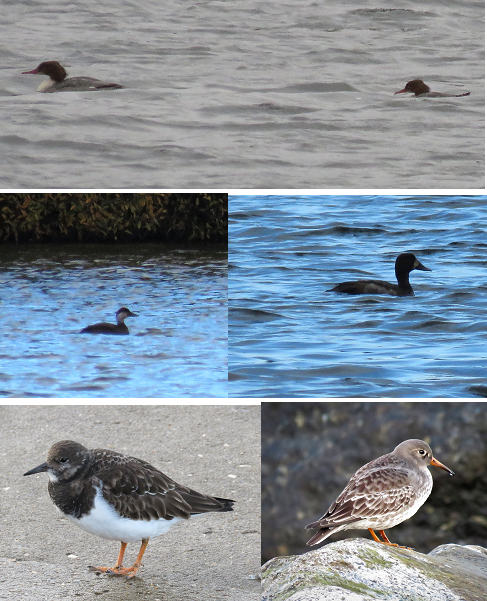
Goosanders
Common Scoter & Scaup (Nov 19th),
Turnstone & Purple Sandpiper (Nov 26th)

Nov 21st Strumpshaw Fen

A bit of a strange day as it seemed empty and quiet, but in the end had some good highlights. There was nothing at Fen Hide (except one marsh harrier) and it was empty at Tower Hide, but between hides, along the muddy path by the river were many fieldfares, redwings and other common woodland tit and finch species, including bullfinches which I only heard calling. I also saw a sparrowhawk on the walk back.

An otter was around on and off at Reception all morning and was close to the hide as far as the measuring post at one point. I also had a large flock of bearded tits in the reeds at the front of the hide, 2-4 marsh harriers, a buzzard, a water rail, but I missed the 3 bitterns fly over, with one landing close by.

It was an ok morning, but my mind was distracted as the World Cup had started and England were about to play Iran while I was waiting for the train home. By the time I got home, they were already 3-0 up. It finished 6-2!

Nov 26th Sheringham

I managed to stray myself away from the football to spend a morning out at Sheringham to sea watch. Could I find anything new over the waves? Well, the sea was actually calm and flat. It wasn't looking like there was going to be anything about.

However, there were some bits and bobs. Mostly red-throated divers, but there were also a flock of 10-20 scoter (where they belong), cormorants, a gannet or two, the usual gull species and a seal. But there was one highlight floating on the sea in the distance that had me puzzling over. It was definitely a diver, but seemed bigger than a red-throated diver and was very dark. The head appeared to be mostly black, the bill seemed to be thicker and every now and then it would lift to flap relatively large wings to reveal a bright white underside. I was more than convinced that this was a great northern diver! Not just new to my list, but new to me as well! Unfortunately, it was too far to photograph.

Mum eventually met up with me after she went into town to kill some time and we had a short stroll along the front hoping to find a purple sandpiper. There were plenty of turnstones and gulls, but it took some searching on the rocks until we finally found one. Unlike the great northern diver, it was more than obliging to pose for a few photos. With this beautiful bird, it takes my 2022 British species total to 176 and 217 overall.

A day later, I heard news of a flock of waxwings was discovered in Sheringham. I was a day early and so I didn't get to see them. What a shame. Just my luck.

Nov 28th Strumpshaw Fen

A very murky, dull day with a lot of mist. I visited Fen Hide, seeing a bittern, 5 marsh harriers, a Chinese water deer and a water rail. Then, as I couldn't make my way to Tower Hide as the path was closed, I made my way along the river to the pumphouse (which was equally muddy in my opinion) and into the woods instead. During the walk, I encountered fieldfares, 2 muntjac deer and at least a hundred siskins spooked out of the trees by a passing train.

It continued to be murky for the rest of the day. The Reception Hide provided distant views of an otter on the far side of the broad in the thick mist and a glimpse of a wing of a bittern as I caught the bird plunging into the reedy islands just a little bit late. Other than that, there reserve seemed very empty and very quiet. 

Strumpshaw has been like that for some time just lately. For a good majority of my visits, there's not even a single duck on the broad. Usually, the broad is full of them by now. It is kind of concerning and a trend that was the same as last year. It feels as if the magic of this place isn't here as much anymore, at least not during the winter and during my shifts especially. It has been a rather forgettable November despite the bitterns, otters and the other things I've seen here throughout this month. At least the World Cup has been exciting.